

What Is the Difference Between White Glove and Special Item Moves?
- Home
- »
- Special Items Move
- »
- What Is the Difference Between White Glove and Special Item Moves?
White glove and special item moves solve two different problems. White glove is a standard of execution, a walkthrough, a placement plan, full blanket wrap, applied to any move regardless of what is being moved. A special item move is triggered by the item itself: its weight, fragility, disassembly needs, or climate sensitivity, which requires specific equipment like a motorized stair climber or archival wrapping. A single move can be one, both, or neither.
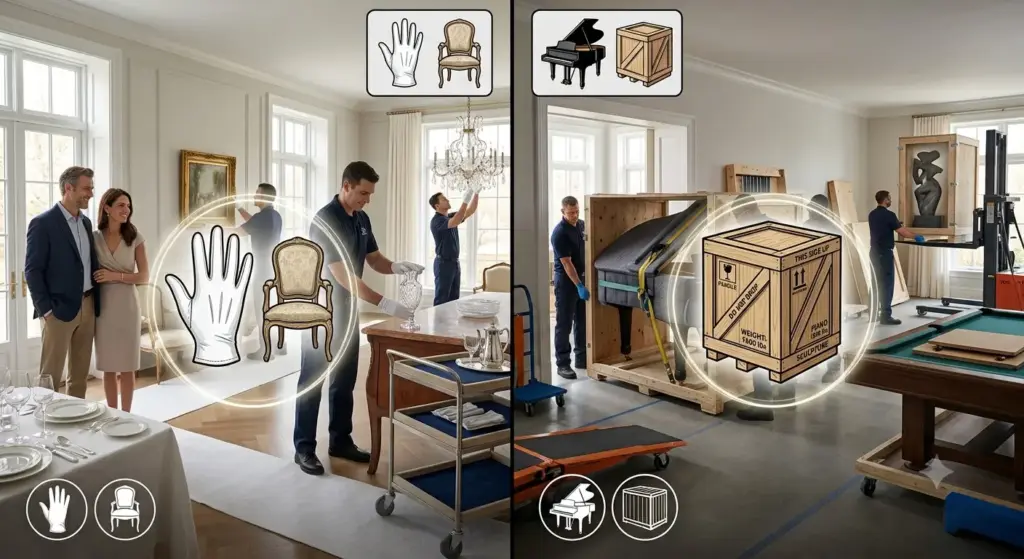
White Glove: A Standard of Execution, Not a Service Category
White glove is not a different type of move, it is a higher standard of execution applied to a move of any size. It includes a pre-move walkthrough of the origin address to identify items that need specific handling, a room-by-room placement plan confirmed with the client before the truck is loaded, protective floor runners and door frame padding at both addresses, blanket wrap on every piece of furniture without exception, and a post-move placement confirmation where the client walks each room before the crew leaves. A studio move at this standard follows the same execution level as a full-home move, the scope changes, the standard does not.
White glove is available as part of any personalized move, confirmed at the quote stage regardless of move size or building type.
Special Item Moves: Triggered by the Item, Not the Service Level
A special item move exists because of what is being moved, not because of how carefully the crew handles the rest of the job. An item qualifies when it exceeds a standard crew-carry weight threshold, fails under standard blanket wrap due to fragility, requires engineered disassembly and reassembly, or is sensitive to temperature or humidity changes. A piano, a heavy safe, fine art, and a wine collection are the clearest examples, and each one needs specific equipment regardless of whether the rest of the move receives white glove treatment or standard handling.
The full breakdown of what qualifies under this classification is covered in what counts as a specialty item when moving, and special item movers in New York City covers the equipment and protocol used for each category.
Where the Two Actually Overlap?
Because execution standard and item classification are independent variables, a single move can fall into any combination of the two. Understanding which quadrant a move falls into clarifies what to ask for when requesting a quote.
Standard item(s) | Special item(s) present | |
|---|---|---|
Standard execution | A typical local move, blanket wrap and careful handling, no walkthrough or placement plan requested | Correct equipment for the item, piano board or archival wrap, without a formal walkthrough or placement plan |
White glove execution | A standard move with a full walkthrough, placement plan, and floor protection added | Both: specialty equipment for the item plus a walkthrough, placement plan, and floor protection for the whole job |
Does White Glove Cost More Than a Standard Move?
On a properly structured quote, white glove does not carry a separate category surcharge, and neither does a special item classification. Both are confirmed at the quote stage and priced on the same all-inclusive hourly basis, with crew size and time allocated to match the scope, whether that scope includes a placement plan, specialty equipment, or both.
Which One Do You Actually Need?
If your concern is how the move is executed, communication, floor protection, a placement plan so furniture lands where you want it the first time, that execution standard is the right thing to ask for regardless of what you own. If your concern is a specific item, a piano, a safe, an art collection, a wine collection, the item itself determines what equipment the crew needs, independent of whether you also want the fuller execution standard for the rest of the job.
For a deep dive into preparing one of the most common special items, see how to prepare a piano for a move, and for the broader risk argument behind hiring a specialist at all, 5 special items you can’t trust just anyone to move covers the specific failure modes involved.
If a special item needs to sit temporarily between addresses regardless of which execution standard applies to the move, appropriate storage conditions still need to match the item, particularly for wine or climate-sensitive art.