

What Counts as a Specialty Item When Moving?
- Home
- »
- Special Items Move
- »
- What Counts as a Specialty Item When Moving?
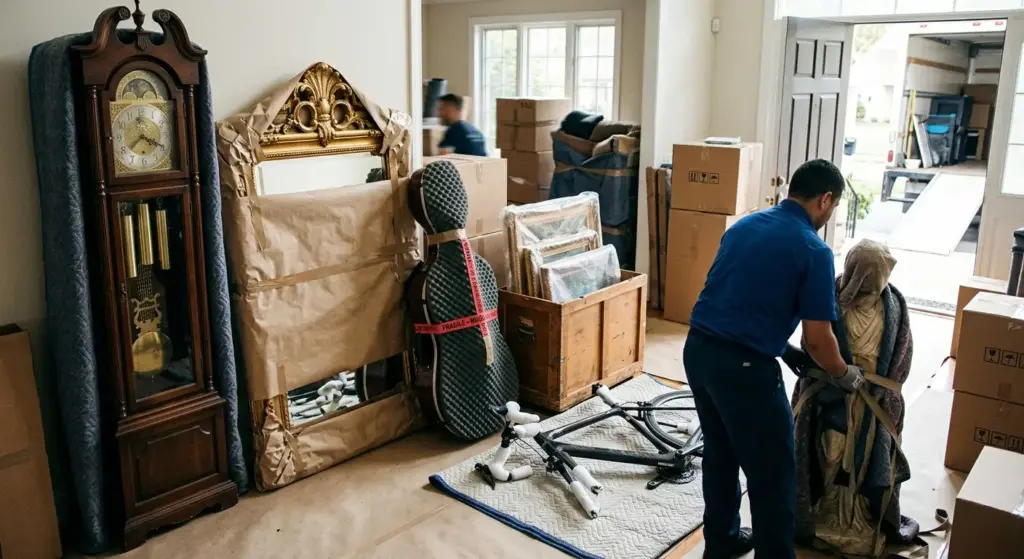
A specialty item is anything that needs equipment, protocol, or handling beyond a standard box-and-blanket move. Pianos, safes, fine art, antiques, wine collections, and pool tables are the most common examples in NYC, but the real test is weight, fragility, disassembly complexity, or climate sensitivity, not the item’s category alone.
The Four Criteria That Actually Define a Specialty Item
Movers do not classify an item as specialty because it looks expensive or unusual. The classification comes down to four specific factors, and an item only needs one of them to qualify.
Criteria | What it means | Example |
|---|---|---|
Weight beyond crew-carry thresholds | Requires mechanical assistance, not just more people | Upright piano, 300 to 900 pounds |
Structural fragility | Fails under standard blanket wrap | Unframed fine art, veneer antiques |
Disassembly complexity | Moved in engineered pieces, reassembled on-site | Pool table slate, home gym equipment |
Environmental sensitivity | Fails outside a temperature or humidity range | Wine collections, some fine art |
Weight: When an Item Needs Mechanical Assistance
An item crosses into specialty territory when its weight exceeds what a crew can safely carry with standard technique, which is the point where a motorized stair climber or specialized dolly becomes necessary rather than optional. Upright pianos weigh between 300 and 900 pounds depending on make and model, more than most safes, and grand pianos add the complication of leg and lyre disassembly before the piece can even be placed on a piano board. Safes range even wider, from 100-pound floor units to 1,500-pound vault installations, and the equipment needed scales directly with that weight.
Weight is confirmed at quote time for every job through special item movers in New York City, since it determines crew size, stair climber load rating, and truck capacity before the crew is ever dispatched.
Fragility: Items That Fail Under Standard Blanket Wrap
Some items are not heavy but still qualify as specialty because standard moving blankets are the wrong protection for their surface. Unframed works on paper, sculptures with exposed surface elements, and antique furniture with delicate veneer or joinery all fall into this category. Archival wrapping and acid-free materials protect these surfaces in ways a standard pad cannot, and the wrong wrapping method can cause compression damage that only becomes visible after the piece has been in transit.
Disassembly Complexity: Items Moved in Engineered Pieces
A pool table is the clearest example of this category: it is never moved as a single unit. The slate bed, which can be a single 500-pound slab or three separate 150-pound sections depending on the table, the frame, the felt, and the legs all travel separately and are reassembled and releveled at the destination. Home gym equipment follows a similar logic, with bolted anchor points and specific disassembly sequences that vary by brand and model.
For the specific question of whether a pool table can skip full disassembly, can a pool table be moved without taking it apart in NYC covers exactly when that is and is not possible.
Environmental Sensitivity: Items That Fail Outside a Temperature Range
Wine collections are the most common environmentally sensitive specialty item in a residential move. A change of more than 20 degrees Fahrenheit, even for a short period, can permanently alter a wine’s flavor profile and compromise provenance for investment-grade bottles, which is why temperature-controlled transport and maintained bottle orientation matter for this category specifically. Certain fine art pieces carry the same sensitivity depending on the medium.
If a specialty item needs to sit somewhere temporarily between addresses, climate-appropriate storage prevents the same kind of environmental damage that a mismatched moving day timeline can cause.
Items That Feel Special But Don’t Qualify as Specialty
Not everything that feels valuable meets the criteria above. Standard furniture, televisions, mattresses, and most kitchen appliances, even expensive ones, move safely with standard blanket wrap and crew handling because they do not exceed the weight, fragility, disassembly, or climate thresholds that trigger specialty classification. Knowing this distinction matters for pricing: specialty items do not carry a surcharge on a properly structured quote, but they do determine which equipment and crew configuration a mover needs to bring.
For a standard move without any specialty items, a full local move covers the pricing and process for everything outside these four categories.
Collections That Mix Specialty and Standard Items
Many moves are not purely one or the other. A collector moving a full apartment might have a piano, several pieces of art, and otherwise ordinary furniture in the same job. This is where a single hourly quote covering both categories matters, since it avoids treating the job as two separate bookings.
For moves with an unusual mix of specialty and standard items, a personalized move plan can be built around the specific combination rather than forcing the job into a standard template.
For fragile or antique-heavy moves specifically, moving companies in Astoria that specialize in fragile or antique items covers what to look for when that category makes up most of the job.