

How to Prepare a Piano for a Move?
- Home
- »
- Special Items Move
- »
- How to Prepare a Piano for a Move?
A piano move succeeds or fails on three things: matching the crew’s equipment to the piano’s exact weight class, giving the instrument two to four weeks to acclimate at the new address before tuning, and confirming every doorway, staircase turn, and elevator dimension before moving day, not during it.
Know Your Piano’s Weight Class Before You Book
Not all pianos are moved the same way, and weight class is the first thing a crew needs to know. A spinet or console piano is the lightest upright category, while a professional upright and a concert grand sit at opposite ends of a very wide range.
Piano type | Typical weight range |
|---|---|
Spinet or console upright | 300 to 400 pounds |
Studio upright | 450 to 500 pounds |
Professional upright | 600 to 900 pounds |
Baby grand | 500 to 650 pounds |
Grand | 700 to 1,200 pounds |
Concert grand | 1,000 to 1,400 pounds |
This range is why a piano move is never quoted from the word piano alone. The make and model determine whether a standard motorized stair climber has sufficient load rating or whether a heavier-duty configuration is needed.
Grand Pianos: What Gets Disassembled and Why?
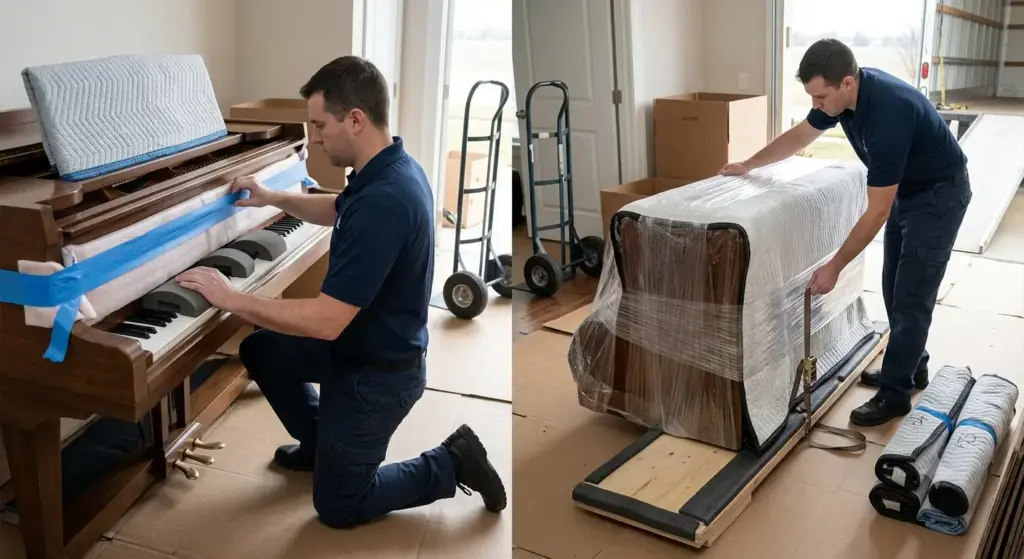
A grand piano is never moved fully assembled. The legs and the lyre, the pedal assembly beneath the keyboard, are removed before the body is wrapped and placed onto a padded piano board for transport. This is not optional or a cost-saving step, it is the only way to move a grand piano’s body through a doorway or onto a stair-climbing dolly safely. Reassembly at the destination includes reattaching the legs and lyre and re-leveling the piano on its new surface.
This falls under the broader category of items moved in engineered pieces, covered in more depth in what counts as a specialty item when moving, which explains why disassembly complexity qualifies an item for specialty handling regardless of its weight.
Measuring Every Doorway, Staircase Turn, and Elevator Before Moving Day
A grand piano’s disassembled body still has a footprint that has to clear every doorway, landing, and elevator interior between its current location and the truck. Measure the narrowest point in the path, not just the doorway the piano currently sits behind, since a stairwell turn or a hallway corner is often the actual constraint. For upright pianos, the concern is usually weight and stair count rather than width, since the cabinet does not disassemble.
This measurement step applies to every specialty item, not just pianos. The general version of this checklist is covered in how to prepare specialty items for moving day, which walks through documentation and building-access steps that apply across categories.
Protecting the Keys, Fallboard, and Casework
Before the crew begins moving the instrument, the fallboard, the hinged cover over the keys, should be closed and locked if your piano has a locking mechanism. Avoid placing any pressure on the keys or pedals during preparation, and clear the top of the piano and the surrounding area completely, since anything left on or near the instrument becomes an obstruction during the lift. The casework, particularly on a polished or antique finish, is protected with padding at the corners and edges specifically, the points most likely to contact a doorway or wall during the move.
Why Climate Acclimation Matters Before Tuning?
A piano’s soundboard and internal wood components expand and contract with humidity and temperature changes, which is why a piano should not be tuned immediately after a move. Give the instrument two to four weeks at the new address to acclimate to the local humidity and temperature before scheduling a tuning, regardless of how carefully the move itself was handled. Moving during extreme heat, cold, or humidity swings, directly from an un-climate-controlled truck into a drastically different environment, increases the acclimation period needed and the risk of tuning instability.
If a piano needs to sit somewhere temporarily between addresses, confirm that any storage facility offers climate control, since an uncontrolled environment can affect the instrument the same way a poorly timed move can.
Why a Piano Move Is Not a DIY or Generalist-Crew Job?
A piano’s weight is unevenly distributed, which makes improvised lifting genuinely dangerous both to the instrument and to whoever is carrying it, and a crew without a properly rated motorized stair climber or specific training on piano weight distribution risks dropping the piece or damaging the internal mechanism through improper tilting. This is not a theoretical risk: it is the single most common cause of piano damage during a move, more common than transport-related scuffs or scratches.
This failure mode and four others are covered in more detail in 5 special items you can’t trust just anyone to move, which explains why equipment and technique matter more for a piano than general care alone.
Booking and Scheduling a Piano Move
Confirm the piano type, brand if known, and both the origin and destination access details at quote time, not after the crew arrives. If your building requires a Certificate of Insurance or a freight elevator reservation, both should be confirmed well ahead of the move date, since a piano move often needs a longer access window than a standard furniture load.
Piano handling is one of the core categories covered by special item movers in New York City. For moves where you also want a full walkthrough and room-by-room placement plan for the rest of the job, that is available as part of a personalized move at the same all-inclusive hourly rate.