

5 Special Items You Can't Trust Just Anyone to Move
- Home
- »
- Special Items Move
- »
- 5 Special Items You Can’t Trust Just Anyone to Move
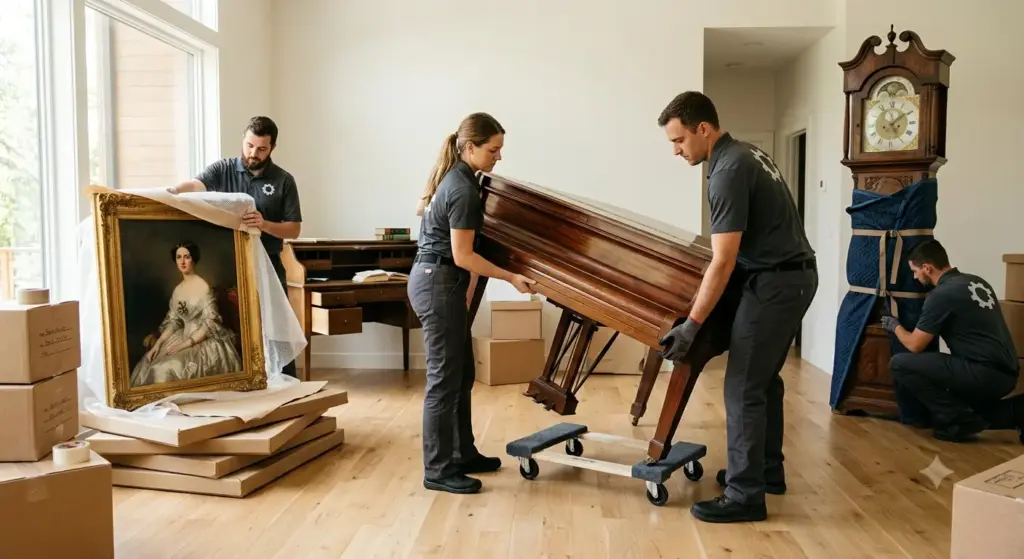
Five categories of belongings are the most likely to be damaged by a generalist moving crew, and each fails in its own specific way without the right equipment or technique. A Yamaha console upright weighs about 502 pounds, a 9-foot concert grand tops 1,000 pounds, and a flagship home safe can weigh more than a compact car, numbers that explain why a dolly rated for a dresser has no business under either one. The damage that does happen is often invisible at move time: a hairline crack in a soundboard, a flavor change in a wine collection from repeated small temperature swings, a crease in a canvas nobody notices until it’s unwrapped. This guide covers the 5 items that call for a specialty mover, the manufacturer-published weight and handling data behind each one, and exactly why each is different from an ordinary piece of furniture.
What Are the 5 Items a Generalist Crew Is Most Likely to Damage?
Pianos, safes, fine art, wine collections, and antique furniture each fail in a distinct, often invisible way.
Item | Why a Generalist Crew Can Damage It |
|---|---|
Grand and upright pianos | Uneven weight distribution; grands need leg and lyre removal and a padded piano board |
Heavy or high-value safes | Entry safes run around 250 pounds, flagship home safes exceed 1,500, and commercial units can top 2,800 |
Fine art and sculpture | Surface abrasion or creasing can go unnoticed until the piece is unwrapped at the new address |
Wine collections | Repeated small temperature swings, not one extreme, push wine through the cork and oxidize it over time |
Antique and heirloom furniture | Older joinery and veneer are vulnerable to compression damage during a standard move |
Why Are Pianos Different From Other Heavy Furniture?
Current manufacturer specifications put a console upright at 502 pounds and a concert grand above 1,000, all of it unevenly distributed.
Piano Category | Manufacturer-Published Weight |
|---|---|
Console upright (U1, 48″) | 502 lbs |
Studio upright (U3, 52″) | 517 lbs |
Compact grand (GB1K/GC1, ~5′-5’3″) | 574 to 639 lbs |
Mid-size grand (C3X/C5X, ~6’1″-6’7″) | 704 to 770 lbs |
Large grand (C6X/C7X, ~7′-7’6″) | 893 to 913 lbs |
Concert grand (CFX, 9′) | 1,069 lbs |
Yamaha’s own published specifications put a 48-inch U1 console upright at 502 pounds and a 52-inch U3 studio upright at 517 pounds, while its grand piano line runs from 574 pounds for a compact 5-foot model up to 1,069 pounds for the 9-foot CFX concert grand. None of that weight sits evenly: a piano’s harp, plate, and strings concentrate most of the mass toward one end, which is exactly why a grand is never moved fully assembled. The legs and lyre come off, and the body goes onto a padded piano board built for that specific load. Our guide to preparing a piano for a move covers the full weight breakdown by model and the disassembly steps in detail.
What’s the Real Risk With a Heavy or High-Value Safe?
An entry-level home safe runs 245 to 411 pounds; a flagship model can exceed 1,500, and a commercial TL-30 unit weighs 2,847 pounds.
Safe Class | Manufacturer-Published Weight |
|---|---|
Entry-level home safe (14-gauge steel) | 245 to 411 lbs |
Flagship home safe (7-gauge steel) | 1,021 to 1,585 lbs |
Commercial TL-30 burglary-rated safe | 2,847 lbs |
A safe’s risk runs in two directions: damage to the building’s floors or stairwell, and injury to a crew lifting without rated equipment. Liberty Safe’s own published specifications show its entry-level Centurion line, built on 14-gauge steel, running from 245 pounds for a 12-gun model up to 411 pounds for a 32-gun model, while its flagship Presidential line, built on 7-gauge steel for serious burglary resistance, runs from 1,021 pounds up to 1,585 pounds depending on size. Commercial and vault-style units go further still: a TL-30 burglary-rated safe from AMSEC, a commercial safe manufacturer, weighs 2,847 pounds in its ACF6024 configuration and needs a forklift or loading dock just to position before a move even starts. The right dolly, ramp, and crew size depend entirely on which end of that range the specific unit falls into, and a mover who hasn’t seen the manufacturer’s weight spec is guessing.
Why Does Fine Art Need Different Handling Than a Picture Frame?
Surface abrasion, creasing, and temperature sensitivity can all go unnoticed until the piece is unwrapped at the destination.
Fine art and sculpture can suffer surface abrasion or creasing that isn’t visible until the piece is unwrapped at the new address, long after the damage happened. Chubb’s “Smart About Moving” guide for fine art collectors specifically discourages bubble wrap for this reason, noting that it “is best avoided as it can leave marks on all but glassy surfaces,” and instead calls for unframed works on paper to be wrapped in glassine, with flat-surface paintings wrapped in glassine and then plastic with the seams taped, and corner pads added to heavy framed pieces once they’re sealed. Temperature-sensitive works also need climate control during transport, which a standard moving blanket and an unconditioned truck don’t provide on their own.
Why Does a Wine Collection Count as a Specialty Item?
Wine is best held between 55 and 60°F with about 70% humidity, and gradual change matters more than any single extreme.
A wine collection doesn’t need to be heavy or fragile in the usual sense to qualify as specialty. Wine Enthusiast’s storage guidance puts the ideal range at 55 to 60 degrees Fahrenheit for both red and white wine, with humidity held near 70 percent so the cork doesn’t dry out. The mechanism matters as much as the target number: temperature swings cause the wine inside the bottle to expand, pushing against the cork and letting in oxygen, and that oxidation “can drain wine of its fruit and freshness” over repeated cycles. A single transport day that starts at 55 degrees and ends at 75 is a bigger problem than a steady 60, which is why a wine collection moved in an uninsulated truck through a hot afternoon is at real risk even if every bottle arrives physically intact.

What Makes Antique and Heirloom Furniture Riskier Than Modern Furniture?
Older joinery, often hide glue and hand-cut dovetails, and veneer bonded decades ago are both more vulnerable to compression damage.
Furniture built before the mid-20th century was typically joined with hide glue rather than the aliphatic resin adhesives used today, and hide glue becomes brittle and can let go under the kind of racking stress a modern dovetail joint would absorb without issue. Veneer applied decades ago is the same story: the animal-hide adhesive bonding a thin wood face to its substrate loses adhesion with age, so a corner that looks solid can separate the moment it’s tilted or set down unevenly. A specialty mover accounts for this before lifting, not after something cracks. Dream Moving’s moving companies that specialize in fragile or antique items guide covers what to look for in that specific expertise.
What About Pool Tables?
Brunswick’s own specs put a 9-foot table at 1,129 pounds, and the slate bed must be re-leveled after reassembly.
Pool tables are a close runner-up to this list. Brunswick Billiards’ own published specifications put a 7-foot table at 638 pounds, an 8-foot table at 797 to 827 pounds depending on pocket style, and a 9-foot table at 1,129 pounds, with most of that weight concentrated in the slate bed rather than the frame. The World Pool-Billiard Association’s tournament equipment standard requires that slate sections, typically three pieces per table, sit flat within .005 inch of each other after leveling and shimming, which is a tolerance a generalist crew has no way to hit without the right tools and experience. Our guide to moving a pool table without taking it apart covers when an intact move is actually possible and when disassembly is the safer call.
How Do You Confirm a Specialty Mover Is Actually Licensed?
Check the mover’s USDOT and MC numbers on the FMCSA’s free public lookup before a piano, safe, or art piece goes on the truck.
Before a high-value item goes on anyone’s truck, it’s worth confirming the mover is who they say they are. The Federal Motor Carrier Safety Administration runs a free public lookup, the SAFER system at safer.fmcsa.dot.gov, where anyone can search a licensed interstate household goods carrier by USDOT or MC number and see its registration and safety record. Dream Moving’s own registration is USDOT 3524817 and MC 1244952, searchable the same way, which is worth checking for any specialty mover you’re considering, not just us. Licensing is only half the question, though; valuation coverage is the other. Under the federal rules at 49 CFR Part 375 Subpart B, a mover’s default liability (Released Value) is capped at 60 cents per pound per article unless you’ve declared full value in writing, and any article worth more than $100 per pound needs to be listed on the shipping documents in advance to recover its actual value if something goes wrong, a detail that matters enormously for a 500-pound piano or a 1,500-pound safe. Our team can walk through exactly what that coverage looks like for a specific item at (212) 994-4941.
What’s the Common Thread Among All 5 Items?
Each needs specific equipment or technique, not just a careful, well-meaning crew.
The case for a specialty mover rests on the equipment and technique these items require, not on any assumption that a generalist crew is careless. Our special item movers service in New York City is built around exactly this: the right equipment matched to the item’s actual, manufacturer-documented weight and construction, every time.
Ready to Move a Specialty Item?
Dream Moving handles pianos, safes, fine art, wine, and antiques with the specific equipment each one requires.
Dream Moving’s special item movers handle all 5 categories above, and a personalized move plan can combine specialty handling with a full move, including furniture assembly and disassembly for anything else that needs to come apart. If your move needs storage in between, that’s available too, with the same climate and handling standards.
Frequently Asked Questions
How much does a piano actually weigh?
What's the risk of moving a safe without specialty equipment?
Can fine art be damaged even with blanket wrapping?
Does temperature really affect a wine collection during a move?
Why are antiques riskier to move than modern furniture?
How can I check that a specialty mover is actually licensed?
Sources
Yamaha, U Series upright piano specifications: https://usa.yamaha.com/products/musical_instruments/pianos/upright_pianos/u_series/specs.html
Yamaha, grand piano size and weight comparison: https://europe.yamaha.com/en/musical-instruments/pianos/explore/size-comparison/
Liberty Safe, Centurion series specifications: https://www.libertysafe.com/products/centurion
Liberty Safe, Presidential series specifications: https://www.libertysafe.com/products/presidential
AMSEC, ACF6024 TL-30 safe specifications (Safe & Vault Store, authorized dealer): https://www.safeandvaultstore.com/products/amsec-acf6024-tl-30-2-hour-fire-rated-burglar-fire-safe
Chubb, “Smart About Moving” fine art handling guide: https://www.chubb.com/content/dam/aem-chubb-global/static-pages/art-advisor/smart-about-moving.pdf
Wine Enthusiast, “Wine Storage 101: Protecting Your Investment”: https://blog.wineenthusiast.com/wine-storage-101-protecting-your-investment/
Brunswick Billiards, Canton 7′, Black Wolf Pro 8′, and Centennial 9′ pool table specifications (Johnson Fitness, authorized retailer): https://www.johnsonfitness.com/Brunswick-Centennial-9′-Pool-Table-P37024.aspx
World Pool-Billiard Association, tournament table and equipment specifications (PoolRoom Billiards): https://www.poolroom.com/tournament-table-equipment-specifications/
FMCSA, 49 CFR Part 375 Subpart B (valuation of household goods): https://www.ecfr.gov/current/title-49/subtitle-B/chapter-III/subchapter-B/part-375/subpart-B
FMCSA, SAFER Company Snapshot lookup: https://safer.fmcsa.dot.gov/CompanySnapshot.aspx
Dream Moving: https://www.dream-moving.com/