

Moving Specialty Inventory: Professional Preparation
- Home
- »
- Special Items Move
- »
- Moving Specialty Inventory: Professional Preparation
A specialty item move goes smoothly when the preparation happens before the crew arrives, not during the walkthrough. Measuring access points against the mover’s actual equipment, photographing condition under the right federal framework, gathering manufacturer-sourced weight data, and confirming both building paperwork and the mover’s own registration all need to happen in advance, since a mover can’t plan equipment or disassembly around information they don’t have yet. This guide covers the preparation steps, backed by the manufacturer specifications and federal rules behind them, that make the difference between a clean specialty move and a damaged one.
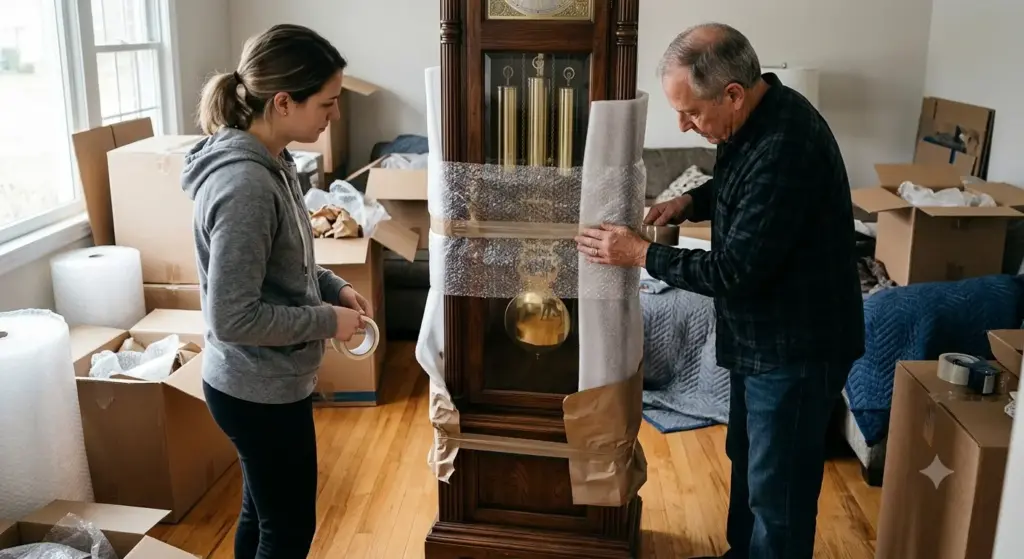
What Preparation Actually Matters Most Before a Specialty Move?
Measuring access, documenting condition, sourcing accurate weight data, and confirming paperwork each prevent a specific kind of problem.
Prep Step | What It Accomplishes |
|---|---|
Measure every access point | Confirms the approach, staircase or elevator, at quote time rather than on move day |
Photograph condition beforehand | Creates a pre-move record that matters under the federal valuation rules |
Gather make, model, and weight | Lets the mover plan the right equipment and any disassembly in advance, using manufacturer specs instead of a guess |
Clear the entire path, not just the item | Specialty equipment needs a wider, flatter route than a standard box |
Confirm building paperwork and mover credentials | COI, freight elevator windows, and the mover’s own USDOT/MC registration all need lead time to verify |
Schedule post-move services in advance | Piano tuning and pool table re-leveling both have their own timelines |
Why Measure Access Points Before You Book?
A standard 2,100-pound-rated passenger elevator cab is only about 5’8″ by 4’4″ inside, well under what a large grand piano or pool table needs to clear.
Rated Capacity | Passenger Cab Interior (W x D) |
|---|---|
2,100 lb | 5’8″ x 4’4″ |
2,500 lb | 6’6″ x 5’0″ |
3,500 lb | 6’8″ x 5’6″ |
Measure doorways, staircase turns, and freight elevator interiors before you request a quote, so the mover can confirm whether the item goes by staircase or elevator while there’s still time to plan around it. The numbers matter more than they might seem: architectural reference data on standard passenger elevator cabs shows a 2,100-pound-rated car running only about 5 feet 8 inches by 4 feet 4 inches inside, and even a 3,500-pound car tops out around 6 feet 8 inches by 5 feet 6 inches. That’s tight clearance for a 9-foot grand piano case or a pool table’s slate sections moving in one piece, which is exactly why those dimensions, not just the doorway, decide whether an item goes up by elevator, by stairs, or needs partial disassembly first. Finding out on move day that a piece doesn’t fit the intended route is one of the most common causes of a specialty move running long.

Why Document Condition With Photos Before the Crew Arrives?
A pre-move photo record matters under the federal valuation rules that cap a mover’s default liability at 60 cents per pound per article.
Photograph fine art, antiques, and any item with existing wear or damage before the crew arrives, creating a pre-move condition record that matters if a valuation or insurance question comes up afterward. This matters more than it might seem: under the federal valuation rules at 49 CFR Part 375 Subpart B, a mover’s default liability (Released Value) is capped at 60 cents per pound per article unless you’ve declared full value in writing, and any article worth more than $100 per pound needs to be listed on the shipping documents in advance to recover its actual value if something goes wrong. Full value protection, the alternative to that default, covers the replacement value of a lost or damaged item up to its declared value, and the rule specifically lets you waive that fuller coverage in writing in favor of the lower released rate, which is a tradeoff worth making deliberately rather than by default. A timestamped photo record protects both you and the mover from a dispute over whether damage was pre-existing, and it’s the kind of documentation that makes a declared-value conversation concrete instead of speculative.
What Information Does a Mover Need for Anything Mechanical?
Manufacturer specs put a piano at 500 to 1,069 pounds and a home safe at 245 to 1,585 pounds, a range too wide for a guess to cover.
Provide the make, model, and weight for safes, pianos, home gym equipment, and pool tables so the mover can plan the right dollies, straps, and disassembly approach in advance. Weight varies widely even within one category: Yamaha’s own published specifications put a console upright at 502 pounds and a 9-foot concert grand at 1,069 pounds, while Liberty Safe’s specifications run from 245 pounds for an entry-level home safe up to 1,585 pounds for its flagship Presidential line, and that’s before a commercial or vault-style unit, which can weigh well over 2,500 pounds, enters the picture. A guess isn’t good enough for equipment planning across a spread that wide. Our guide to preparing a piano for a move shows exactly what that looks like for one specific item type, with the full weight table by model.
Why Clear the Path, Not Just the Item?
Specialty equipment needs a wider, flatter route than a standard box, so rugs, furniture, and décor need to come out of the way first.
Clear rugs, furniture, and décor from the entire route to the truck, not just around the specialty item itself. Specialty equipment like a piano board or a rated dolly needs a wider, flatter path than a crew carrying a standard box, so an obstacle a few feet from the item can still slow the whole move down. If other furniture along that path needs to come apart to open the route, Dream Moving’s furniture assembly and disassembly service handles that as part of the same visit.
What Building Paperwork and Mover Credentials Need to Be Confirmed Before Moving Day?
A Certificate of Insurance needs lead time in a managed building, and the mover’s own USDOT/MC registration is worth checking before booking.
Managed buildings typically require a Certificate of Insurance, and a freight elevator window should be confirmed with the superintendent well in advance, since specialty moves often need a longer booked window than a standard move. It’s also worth confirming the mover itself is properly registered before any of that paperwork gets finalized. The Federal Motor Carrier Safety Administration’s free SAFER lookup at safer.fmcsa.dot.gov lets anyone search a licensed interstate household goods carrier by USDOT or MC number and see its registration status. Dream Moving’s own registration, USDOT 3524817 and MC 1244952, is searchable the same way, which is a habit worth forming for any specialty mover you’re vetting, not just us. If you have questions about how that registration connects to valuation coverage for a specific piano, safe, or art piece, our team is reachable directly at (212) 994-4941.
What Post-Move Services Should You Schedule in Advance?
Piano manufacturer Petrof recommends about six weeks before tuning; a pool table’s slate needs re-leveling to a .005-inch tolerance after reassembly.
Book a piano tuning after the instrument has had time to acclimate to the new space. Piano manufacturer Petrof’s own published guidance recommends allowing about six weeks for a moved piano to adjust to new climate conditions before tuning, since humidity, more than temperature alone, is the primary driver of detuning as the wood and felt components respond to the new environment; tuning too soon risks the piano drifting back out of tune as it keeps adjusting. A pool table’s slate needs re-leveling after reassembly to the same tolerance tournament equipment is held to, flat within .005 inch across the joined sections, which is usually scheduled as part of the move itself rather than as a separate follow-up appointment.
What Changes When the Specialty Item Is Going Into Storage or Moving Long-Distance?
Longer transit and storage time both increase exposure to the temperature and humidity swings that damage wine, art, and pianos.
A specialty item sitting in an unconditioned truck or warehouse for days rather than hours faces a longer window for exactly the kind of temperature and humidity swing that causes damage. Wine is the clearest example: Wine Enthusiast’s storage guidance notes that a temperature swing causes the wine inside the bottle to expand and push against the cork, letting in oxygen that oxidizes the wine over repeated cycles, so a long-distance move spanning several days of transit deserves climate-aware handling, not just careful loading. The same logic applies to a piano’s soundboard and a painting’s canvas. If the gap between pickup and delivery means the item needs to sit somewhere in between, confirm in advance that any storage used for climate-sensitive pieces actually holds a stable temperature and humidity range, rather than assuming any storage unit will do.
What Shouldn’t You Do Yourself?
Don’t disassemble a piano, pool table, or gym equipment without the mover, and don’t wrap fragile art or antiques incorrectly beforehand.
- Don’t disassemble a piano, pool table, or home gym setup on your own before the crew arrives
- Don’t wrap fragile art or antiques yourself without confirming the right materials with your mover first; bubble wrap in particular is often the wrong choice for a finished surface
- Check that any temporary storage you’re using actually suits climate-sensitive items before you book it
- Don’t skip verifying the mover’s USDOT/MC registration just because the quote looked reasonable
Ready to Prepare for a Specialty Move?
Dream Moving’s special item movers walk through this preparation checklist with you before booking day.
Dream Moving’s special item movers walk through this preparation checklist with you at booking, and a personalized move plan can combine specialty prep with the rest of your move. Need storage in between? That’s available with the same handling standards, and our guide to narrow hallways and walk-ups in NYC covers the access-planning side of older buildings specifically.
Frequently Asked Questions
Do I need to measure doorways before booking a specialty move?
Should I photograph art or antiques before movers arrive?
What does a mover need to know about my piano?
Should I disassemble my pool table myself before the move?
When should I schedule a piano tuning after a move?
How do I check that a specialty mover is properly registered?
Does a specialty item need different handling for a long-distance move than a local one?
Sources
FMCSA, 49 CFR Part 375 Subpart B (valuation of household goods): https://www.ecfr.gov/current/title-49/subtitle-B/chapter-III/subchapter-B/part-375/subpart-B
FMCSA, SAFER Company Snapshot lookup: https://safer.fmcsa.dot.gov/CompanySnapshot.aspx
Yamaha, U Series upright piano specifications: https://usa.yamaha.com/products/musical_instruments/pianos/upright_pianos/u_series/specs.html
Yamaha, grand piano size and weight comparison: https://europe.yamaha.com/en/musical-instruments/pianos/explore/size-comparison/
Liberty Safe, Centurion and Presidential series specifications: https://www.libertysafe.com/products/presidential
Petrof, piano tuning frequency and post-move acclimation guidance: https://www.petrof.com/news-how-often-should-a-piano-be-tuned
World Pool-Billiard Association, tournament table and equipment specifications (PoolRoom Billiards): https://www.poolroom.com/tournament-table-equipment-specifications/
LearnArchitecture.net, passenger elevator cab dimensions by capacity: https://learnarchitecture.net/architecture-design/36179-elevator-dimensions.html
Wine Enthusiast, “Wine Storage 101: Protecting Your Investment”: https://blog.wineenthusiast.com/wine-storage-101-protecting-your-investment/
Dream Moving: https://www.dream-moving.com/