

Can you move a pool table without taking it apart in NYC?
- Home
- »
- Local Moving
- »
- Can you move a pool table without taking it apart in NYC?
Moving a pool table intact is possible, but only when the doorways, hallways, and turns along the entire path are wide enough and the right equipment is on hand. Brunswick Billiards’ own published specifications put a 7-foot table at 638 pounds and a 9-foot table at 1,129 pounds, with most of that weight concentrated in the slate bed rather than the frame, which is exactly what makes an intact move risky if the equipment isn’t rated for the load. This guide covers when an intact move genuinely works, the manufacturer and trade-association data behind the equipment it takes, and when disassembly is the safer and ultimately cheaper choice.
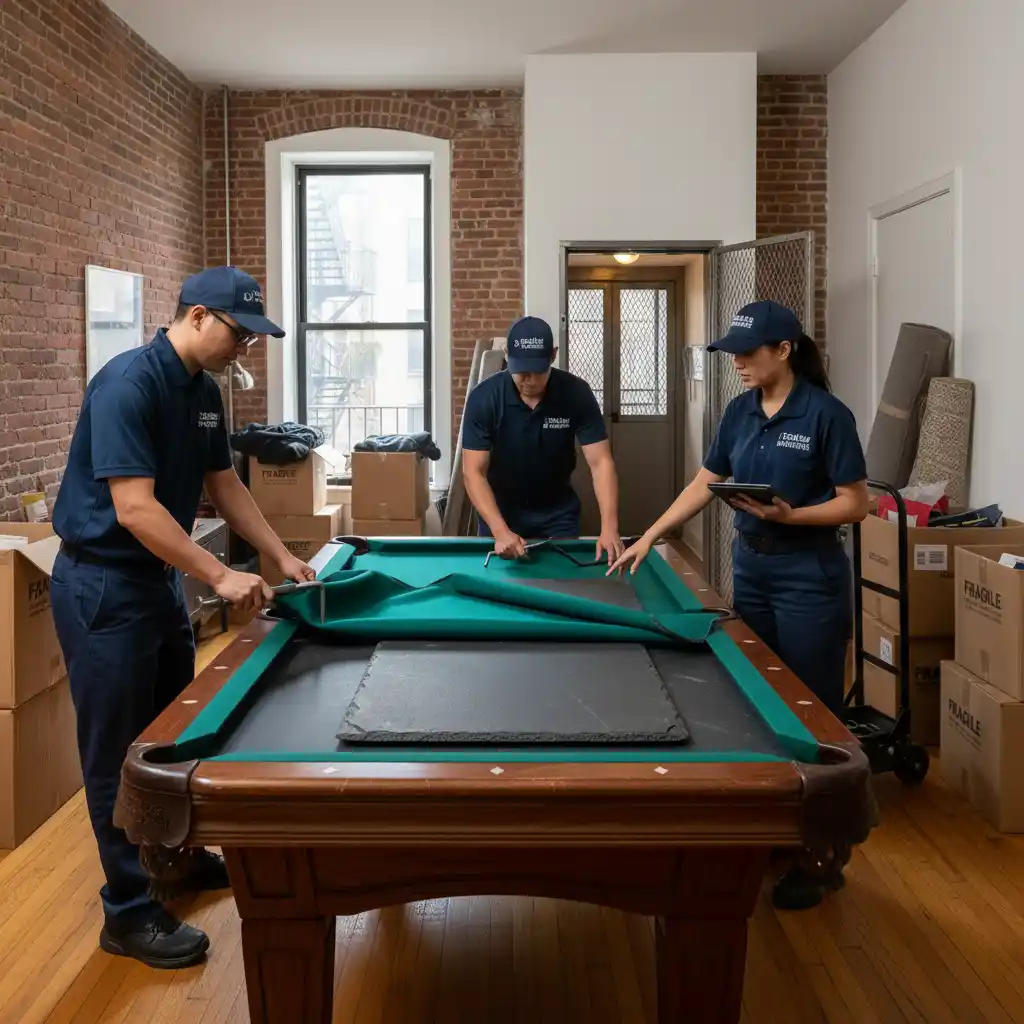
How Much Does a Pool Table Actually Weigh?
Brunswick’s own specs run from 638 pounds for a 7-foot table up to 1,129 pounds for a 9-foot table, most of it in the slate bed.
Table Size (Brunswick Model) | Manufacturer-Published Weight |
|---|---|
7-foot (Canton) | 638 lbs |
8-foot (Black Wolf Pro, drop pocket / gully) | 797 to 827 lbs |
9-foot (Centennial) | 1,129 lbs |
What Actually Makes a Pool Table Hard to Move?
The slate’s seams, the frame’s weight tolerance, and the felt all fail in specific ways if the table is tilted or lifted incorrectly.
WPA Tournament Slate Specification | What It Means for a Move |
|---|---|
3 equal-size slate pieces per table | Each section has to be lifted, carried, and reseated independently |
Minimum 1-inch slate thickness | Slate is heavy for its size, which is why it accounts for most of the table’s total weight |
Joints flat within .005 inch after leveling and shimming | A re-level after a move has to hit this tolerance for the table to play true, not just look even |
Slate fastened with countersunk screws or bolts into a wood frame | The frame underneath has to be intact and square, or the slate won’t seat correctly |
Tournament-grade slate, per the World Pool-Billiard Association’s own equipment specification, comes in three equal-size sections at least 1 inch thick, fastened to the wood base frame with countersunk screws or bolts, and the joints between those sections have to sit flat within .005 inch of each other after leveling and shimming. That’s not a cosmetic standard; it’s the tolerance a table needs to play true, and it’s tighter than most home levels can even measure, which is why a professional re-level uses machinist-grade levels and shims rather than a carpenter’s bubble level. The sections are joined with a filler compound at the seams, traditionally beeswax, sometimes a two-part epoxy filler, and that seal can loosen with age, temperature swings, or repeated vibration, which is why tilting or lifting the table incorrectly risks cracking the seal, not just the slate itself. The frame and legs aren’t built to bear the slate’s full weight when the table is tilted, so they can crack or the mounting screws can pull out, and the felt can tear or shift if the table moves without the right support underneath it.
What Does It Take to Move a Pool Table Intact?
Doorways at least 36 inches wide, at least 4 movers, and dollies rated for 1,200 pounds or more.
What You Need for an Intact Move | Why It Matters |
|---|---|
Doorways at least 36 inches wide along the whole path | The practical minimum clearance for the table itself in motion, not just at rest |
At least 4 movers | A table weighing 638 to 1,129 pounds in an awkward shape needs more hands than a typical furniture piece |
Dollies rated for 1,200 lbs or more | A standard furniture dolly isn’t rated for a pool table’s weight and shape, which concentrates in the slate |
The gap between an 8-foot and a 9-foot table matters more than the one-foot difference suggests. At 797 to 827 pounds versus 1,129 pounds by Brunswick’s own specifications, a 9-foot table is roughly 35 to 40 percent heavier, which pushes the crew size and dolly rating up a full step rather than a small increment. A set of hydraulic or appliance-rated dollies, rather than standard furniture dollies, distributes that weight across a wider footprint and lets the crew make small steering adjustments without having to lift and reposition the table repeatedly, which is where most in-transit tilting incidents happen.

What’s the Step-by-Step Process for an Intact Move?
Secure the pockets and rails, support the slate from underneath, and move slowly with a spotter at every turn.
- Secure the pockets and rails so nothing shifts during transport
- Support the slate bed from underneath throughout the move, never letting it bear weight unevenly across its three sections
- Use a spotter at every doorway, turn, and incline to confirm clearance before moving, since a table that clears a doorway can still fail to clear the turn beyond it
- Re-level the table once it’s in its final position to the same .005-inch tolerance tournament equipment is held to, since even a careful intact move can shift it slightly
What Happens to the Felt During an Intact Move?
Felt that’s in good condition and handled carefully can often be kept; an intact move avoids the re-stretching that disassembly and reassembly require.
One advantage of an intact move is that the felt never has to come off, which avoids the re-stretching that happens whenever a table is disassembled and the cloth reinstalled. Felt in good condition can generally make an intact move without issue as long as it’s protected from snagging on doorframes or hardware during transport; felt that’s already worn, stained, or loose at the rails is a reasonable point to consider replacing regardless of which way the table moves, since a move is a convenient time to do it while the table is already being handled by a crew. The pockets and rail cushions travel with the frame either way and don’t factor into this particular decision.
When Is Disassembly the Right Choice Instead?
Any move involving stairs, a long distance, or doorways under the minimum clearance calls for disassembly.
Disassembly is the right call whenever the move involves stairs, a significant distance, or any doorway or turn under the minimum clearance an intact move needs. It’s also the safer default whenever there’s genuine doubt about whether the path will accommodate the table’s full size in motion, since a table stuck mid-move, wedged in a doorway or a stairwell landing, is far more likely to end in damage to the slate seal or the frame than a planned disassembly would have been. An intact move typically takes meaningfully less time than a full disassembly, transport, reassembly, and re-level, since there’s no slate to unbolt, crate, and reseat to a .005-inch tolerance on the other end, which is exactly why it’s worth confirming the path can actually support it before assuming disassembly is the default.
What Does a Pool Table Move Typically Cost?
Cost depends heavily on whether the table can be moved intact or needs full disassembly and re-leveling.
An intact, same-floor move costs considerably less than a full disassembly, transport, reassembly, and re-leveling job, since the labor and time involved differ substantially between the two; disassembly means handling three slate sections, each requiring careful lifting and precise reseating to that .005-inch tolerance, rather than moving one assembled unit a short distance. Table size factors in directly too: a 1,129-pound 9-foot table takes more crew time to disassemble and reassemble than a 638-pound 7-foot table, independent of distance. Get a quote based on your specific table size, distance, and path, since a generic number won’t reflect what your particular move actually requires, and ask the mover to confirm upfront whether they’re quoting for an intact move or a full disassembly, since those are two different jobs with different equipment and time.
Is This Different for a Move Within NYC?
Yes. Building access in NYC, elevators, pre-war stairwells, and COI requirements, changes the calculation significantly.
Yes. Elevator dimensions, narrow pre-war stairwells, and Certificate of Insurance requirements are specific enough to NYC buildings that they deserve their own breakdown. Our guide to moving a pool table without taking it apart in NYC covers those specific challenges in depth.
How Do You Confirm a Pool Table Mover Is Properly Licensed?
A table weighing over 1,100 pounds is worth entrusting only to a mover whose USDOT/MC registration you’ve actually checked.
A 1,129-pound table, or the 2,847-pound commercial safe or 1,069-pound concert grand that might be on the same moving crew’s schedule the same week, is worth entrusting only to a company whose registration you’ve actually checked. The FMCSA’s free SAFER lookup, at safer.fmcsa.dot.gov, lets you search a licensed interstate household goods carrier by USDOT or MC number and see its registration and safety record. Dream Moving’s own registration is USDOT 3524817 and MC 1244952, searchable the same way, which is worth checking for any specialty mover you’re considering before a table this heavy goes on its truck. Questions about valuation coverage for a specific table can go directly to our team at (212) 994-4941.
Ready to Book Your Pool Table Move?
Dream Moving’s special item movers assess your specific table and path before recommending intact or disassembled.
Dream Moving’s special item movers assess your table’s size and path before recommending an intact move or disassembly, as part of the same preparation process we walk every specialty item through. Contact Dream Moving with your table size and move details for an accurate quote.
Frequently Asked Questions
Can a pool table be moved without taking it apart?
How much does a pool table weigh?
How many movers does a pool table move need?
Does moving a pool table damage the slate?
When should a pool table be disassembled instead of moved intact?
What tolerance does a pool table's slate need to be re-leveled to?
How can I check that a pool table mover is actually licensed?
Is an 8-foot or 9-foot table significantly harder to move than a 7-foot one?
Can old felt be reused after an intact pool table move?
Sources
Brunswick Billiards, Canton 7′, Black Wolf Pro 8′, and Centennial 9′ pool table specifications (Johnson Fitness, authorized retailer): https://www.johnsonfitness.com/Brunswick-Centennial-9′-Pool-Table-P37024.aspx
World Pool-Billiard Association, tournament table and equipment specifications (PoolRoom Billiards): https://www.poolroom.com/tournament-table-equipment-specifications/
FMCSA, SAFER Company Snapshot lookup: https://safer.fmcsa.dot.gov/CompanySnapshot.aspx
Dream Moving: https://www.dream-moving.com/