How to Prepare a Safe for a Move in NYC in 2026
- Home
- »
- Special Items Move
- »
- How to Prepare a Safe for a Move in NYC in 2026
A safe’s weight class, not its size, decides what the move actually requires. A small-looking fireproof box can weigh more than a piece of furniture twice its size, and that concentrated weight is what puts floors, stairwells, and crew at risk. Check your safe’s weight before you book, not on moving day.
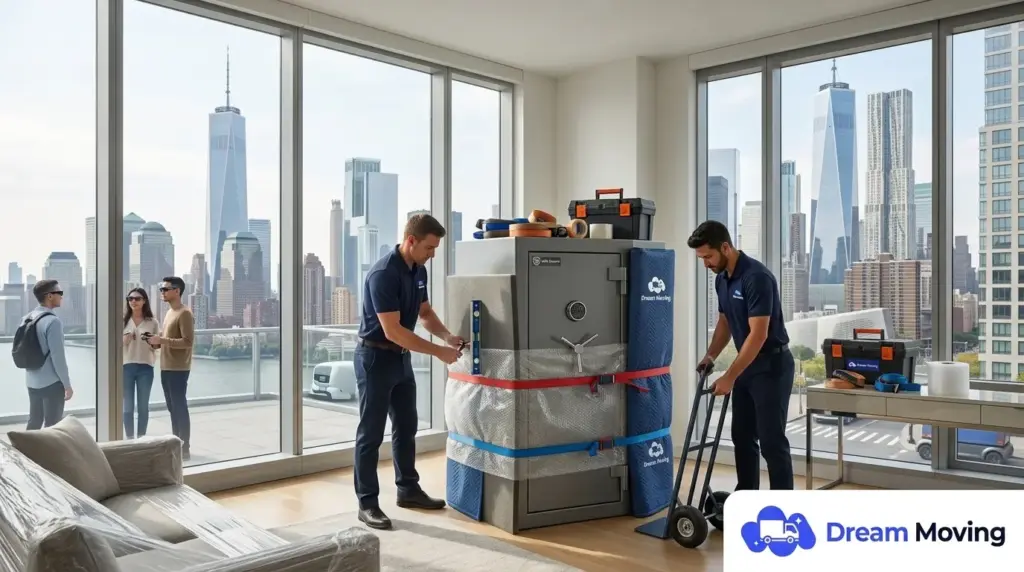
Know Your Safe’s Weight Class Before You Book
Home safes generally fall into a few weight classes, and the class decides the crew and equipment, not the safe’s footprint.
Entry-level home and gun safes typically run 245 to 411 pounds. Mid-size and flagship models move into 1,021 to 1,585 pounds. Commercial-grade TL-30 safes can reach 2,847 pounds. A safe that looks compact can still sit in the heaviest class once you account for the steel and fill material inside the walls, so the honest answer is to check the model’s published weight rather than guess from size.
Why Floors and Stairwells Are the Real Risk
A safe’s weight sits on a small footprint, which is what makes floors and stairwell landings the real danger, not the hallway.
Furniture spreads its weight across legs or a wide base. A safe concentrates hundreds of pounds on a few square feet, which is exactly what stairwell landings and older floor joists aren’t built for. That concentrated load, combined with an awkward grip point, is also what causes crew injury on a safe move more often than on a standard furniture move. Specialized dollies rated for the weight class, not moving straps alone, are what actually make the carry safe.
What to Confirm Before Moving Day
Confirm the path, the building’s paperwork, and the declared value before the crew arrives, not after.
Measure the path to the truck the same way you would for a piano, since a safe’s weight matters more on turns and landings than its width. If the building has a managed freight elevator, the same Certificate of Insurance rules that apply to other heavy items apply here. Under standard moving liability, cargo is covered at a default rate of $0.60 per pound unless you declare a higher value in advance, which matters for a safe holding more than its own weight in contents.
Weight Class | Typical Range | What It Means for the Move |
Entry-level | 245 to 411 lbs | Standard heavy-item handling, no special equipment beyond rated dollies |
Mid-size to flagship | 1,021 to 1,585 lbs | Multiple crew, rated equipment, path and floor-load check |
Commercial TL-30 | Up to 2,847 lbs | Requires planning similar to a piano or pool table move |
Dream Moving handles safes across all five boroughs as a special item move. Contact us at (212) 994-4941 with the model and weight so we can plan the right crew and equipment.