

COI for NYC Moves: What It Is and Why Your Building Requires It?
- Home
- »
- Local Moving
- »
- COI for NYC moves: What is it and why does your building require it?
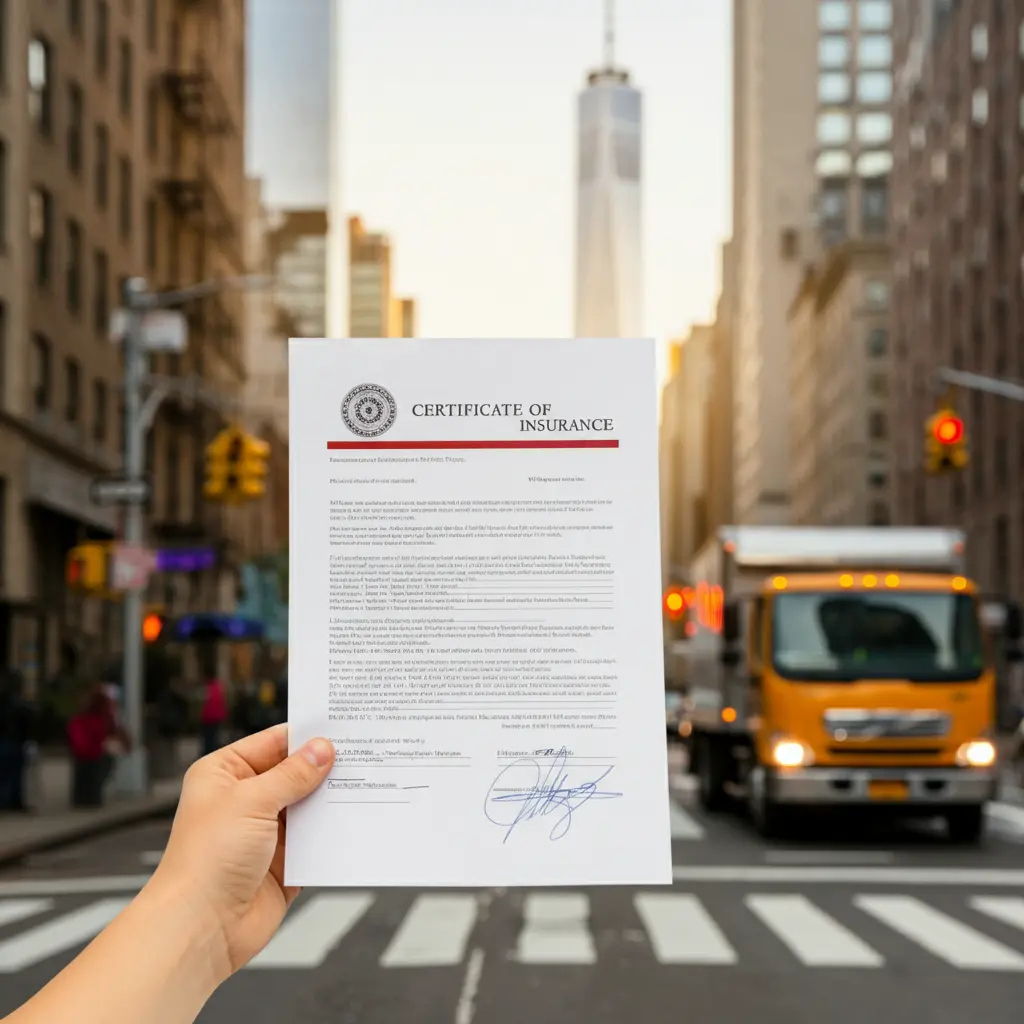
A Certificate of Insurance (COI) is a one-page document issued by a moving company’s insurance carrier confirming active general liability coverage, with the building named as an additional insured for the move date. Most NYC residential buildings with more than 6 units require one before granting service entrance or freight elevator access. Processing takes 24 to 48 business hours for a standard request and 3 to 5 additional business days if the building specifies a particular insurance carrier. Local moving services from Dream Moving include COI preparation and filing at no additional charge on every booking.
What a Certificate of Insurance actually contains?
A COI is a standardized one-page summary of an insurance policy, typically formatted using the ACORD 25 industry-standard template. It is not the insurance policy itself, which can run dozens of pages; it is a certified summary that lists the specific coverage types and limits that apply.
Field on the COI | What it shows | Why it matters to your building |
|---|---|---|
Insured party | The moving company’s legal name, exactly as licensed | Must match the company you hired, not a sub-contractor |
Certificate holder | Your building’s management company or board, listed by name and address | Confirms the COI is issued specifically for your move, not a generic copy |
General liability limit | Typically $1,000,000 per occurrence, $2,000,000 aggregate for most NYC buildings | Most co-op and condo boards set a minimum; some Manhattan Class A buildings require higher limits |
Additional insured endorsement | Confirms the building is added to the policy as an additional insured party for the move date | Without this endorsement, the building has no direct claim against the mover’s policy |
Policy period | Effective and expiration dates of the underlying insurance policy | Must cover the actual move date; an expired policy invalidates the COI |
Description of operations | States the specific move date and address | Generic COIs without a specific date are frequently rejected by building management |
Why NYC buildings require a COI before move day?
Building management requires a COI for one operational reason: it shifts financial responsibility for move-related damage from the building’s own insurance policy to the moving company’s policy. Without a COI on file, a building that incurs damage during a move has only two paths to recovery: pursuing the resident directly, who may not have adequate coverage, or filing against its own master policy, which raises future premiums for the entire building.
The risk a COI addresses is concrete: elevator interior panels (cost to repair: $500 to $3,000), lobby flooring (marble repair can run $1,000 to $5,000 per damaged section), and hallway walls (drywall and paint repair: $200 to $800 per damaged section) are the most commonly damaged areas during NYC moves. A COI ensures the mover’s insurance, not the building’s, responds to any of these.
A secondary function is screening. A company that can produce a COI on request has, at minimum, an active general liability policy, which filters out unlicensed or uninsured operators. This is not a perfect screen since a COI does not confirm USDOT licensing or operational competence, but it is the minimum bar most buildings set.
How long COI processing actually takes?
Scenario | Processing time | What causes the variation |
|---|---|---|
Standard COI, no special carrier requirement | 24 to 48 business hours | Standard request to the mover’s existing insurance carrier; most common scenario |
Building specifies a non-standard carrier or higher limits | 3 to 5 additional business days | Requires a custom endorsement from the insurance carrier rather than a standard certificate |
Building requires the certificate holder name spelled exactly per their management agreement | No added time if provided correctly at request; 1 to 2 day delay if corrections are needed | Common cause of rejection: certificate holder name does not match the building’s legal entity name exactly |
Weekend or holiday request | Processing typically resumes the next business day | Most insurance carriers process COI requests only during business hours, Monday through Friday |
The practical implication: request the COI requirements from your building at least 5 business days before your move date for a standard request, and 10 business days if your building specifies a particular carrier or unusual limits. Requesting on the day of booking, rather than days later, is the single most effective way to avoid a move-day delay.
What happens if the COI is rejected or missing on move day?
Building management or the doorman staff checks the COI against the building’s specific requirements before granting freight elevator or service entrance access. The most common rejection reasons, in order of frequency, are:
- Certificate holder name does not exactly match the building’s legal management entity name (the single most common rejection reason)
- Coverage limits below the building’s stated minimum (commonly $1 million per occurrence; some buildings require $2 million)
- Policy period does not cover the actual move date
- Additional insured endorsement missing or not specific to the move
- COI not received by the building’s deadline, commonly 24 to 48 hours before move day
If a COI is rejected or missing entirely on move day, the building has the right to deny the moving crew access to the elevator and service entrance. The move does not legally proceed until a corrected COI is accepted. This typically means either: a same-day correction if the issue is minor (a name correction can sometimes be resubmitted within hours), or a full rescheduling of the move if the building requires advance notice for any move (commonly 24 to 48 hours), which means a rejected COI on move day frequently results in a lost moving day entirely.
How to verify your mover's COI before move day?
Verification before move day, not on it, is the only way to catch a problem with enough time to fix it. These are the specific checks to make:
- Confirm the insured party name on the COI matches the moving company’s legal name exactly, not a similar-sounding name (a common broker red flag)
- Confirm the certificate holder field lists your specific building’s management entity, not a generic or different building name
- Confirm the general liability limit meets or exceeds your building’s stated minimum, commonly found in your lease or move-in policy document
- Confirm the policy period covers your actual move date
- Confirm the description of operations field, if present, references your specific move date and address
- If anything looks inconsistent, call the insurance company listed on the COI directly using the phone number on the document, not a number provided by the mover, to confirm the policy is active
Request a copy of the COI for your own records as soon as it is issued, separate from the copy sent to your building. This gives you the ability to verify the details yourself rather than relying entirely on the building staff to catch an error.
COI, USDOT registration, and general liability insurance: how the three relate?
These three concepts are related but distinct, and confusing them is common.
Term | What it confirms | How to check it |
|---|---|---|
USDOT number | The company is registered as a licensed interstate or intrastate motor carrier with the FMCSA | Look up at safer.fmcsa.dot.gov; shows registration status and safety record |
General liability insurance | The underlying insurance policy that covers property damage and bodily injury claims against the company | Confirmed by the existence of an active policy; the COI is the proof document for this |
Certificate of Insurance (COI) | A point-in-time certified summary proving the general liability policy is active and naming a specific building as additional insured | Request directly from the mover; verify details against the checklist above |
A company can have an active USDOT number without adequate general liability insurance, and vice versa, though reputable movers maintain both. Checking the USDOT number confirms the company is a legitimate, registered carrier. Verifying the COI confirms insurance specific to your move and your building. Both checks matter and address different risks.
How Dream Moving handles the COI process?
Dream Moving (USDOT 3524817, MC 1244952, headquartered at 24-13 45th St, Astoria) files COIs at no additional charge on every booking. The process: provide the building’s COI requirements (a forwarded email from management, or the management company’s contact information) at the time of booking; Dream Moving’s team contacts the building directly to confirm specific requirements; the COI is processed with the insurance carrier and sent to the building, typically within the standard 24 to 48 business hour window. For the full pre-hire question script that includes the right way to ask any mover about their COI process, see questions to ask a residential moving company before hiring in Astoria.
Frequently Asked Questions about COI for NYC moves
What is a Certificate of Insurance (COI) for an NYC move?
Why does my NYC building require a COI for moving?
How long does it take to get a COI for a move?
What is the most common reason a COI gets rejected?
What happens if my mover shows up without a valid COI?
How do I verify that a moving company's COI is legitimate?
Is a USDOT number the same thing as a COI?
Related reading
For the full mover evaluation checklist that includes COI handling as one of five core criteria, see what to look for when choosing a residential moving service in Astoria.
For why COI processing time sets the minimum booking lead time for any NYC move, see how far in advance should you book a residential mover in Astoria.