

What Can't Office Movers Move?
- Home
- »
- Commercial Moving
- »
- What Can’t Office Movers Move?
Office movers cannot transport hazardous materials, regulated substances, live biological samples, perishable items, uninsured high-value assets, or items that require a specialized license to handle. In a commercial office context, that list is longer than most businesses expect: it includes battery UPS systems, fire suppression chemicals, DEA-scheduled medications in medical practice break rooms, and cash. Dream Moving identifies non-allowable items during the pre-move survey and arranges compliant handling for each category before moving day.
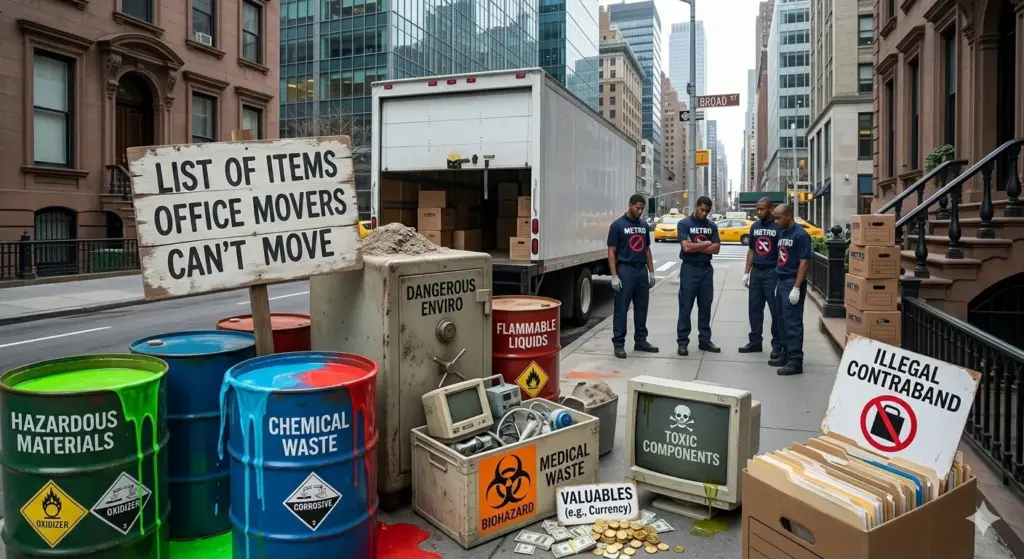
The Four Categories of Items Office Movers Cannot Move!
Non-allowable items in a commercial office move fall into four distinct categories. Each has a different reason for the restriction and a different solution. Knowing which category an item falls into determines the right way to handle it before the truck arrives.
Category | What It Covers and Why Movers Cannot Transport It |
1. Federally regulated hazardous materials | Items classified as flammable, explosive, corrosive, toxic, or pressurized under FMCSA and DOT regulations. Movers licensed as household goods carriers are legally prohibited from transporting these regardless of quantity. Violations carry federal penalties. |
2. Regulated substances and controlled items | DEA-scheduled medications, medical gas cylinders, biological samples, firearms, and ammunition. Each requires a specific federal or state license to transport that standard commercial movers do not hold. |
3. High-value or uninsurable assets | Cash, negotiable instruments, bearer bonds, original signed contracts, and irreplaceable items that cannot be adequately covered under a commercial moving insurance policy. Movers decline these because liability exposure exceeds coverage limits. |
4. Items requiring specialist handling outside moving scope | Live plants requiring USDA phytosanitary documentation for interstate moves, perishable food and beverages, and pets. These require specialist transport services that fall outside FMCSA-licensed moving operations. |
Hazardous Materials Found in NYC Offices That Movers Cannot Touch
The hazardous materials list for an office move is longer than most businesses realize. Offices contain regulated items in places staff walk past every day without thinking about them as hazardous. Each one needs to be removed, disposed of, or separately transported before the moving crew arrives.
Break Rooms and Kitchen Areas
Item | Hazard Classification | Correct Handling |
Propane or butane canisters (portable stove tops) | Flammable compressed gas | Dispose at NYC DSNY hazardous waste drop-off event or return to retailer |
Aerosol cleaning sprays, air fresheners | Pressurized flammable | Use up before move date or dispose at DSNY drop-off |
Fire extinguishers | Pressurized | Building management typically takes responsibility; confirm before move date |
Undiluted cleaning concentrates | Corrosive | Dispose or transfer to building maintenance; do not pack |
Server Rooms and IT Closets
Item | Hazard Classification | Correct Handling |
UPS (uninterruptible power supply) battery systems | Lead-acid or lithium battery regulated waste | IT vendor or licensed battery recycler must disconnect and transport separately; not a mover responsibility |
Halon or FM-200 fire suppression systems | Pressurized regulated gas | Licensed fire suppression contractor must depressurize and certify before move; this is a building infrastructure task |
Lithium battery packs in rack-mounted equipment | Lithium battery regulated | IT vendor manages; Dream Moving can transport equipment once batteries are removed or confirmed compliant |
Backup generator fuel (diesel or gasoline) | Flammable liquid | Drain completely and certify empty; licensed fuel vendor handles surplus |
General Office Areas
Item | Hazard Classification | Correct Handling |
Toner cartridges (unused, bulk) | Potential chemical irritant at volume | Ship separately via manufacturer return program or courier; do not load loose |
Copier chemicals and developer fluid | Chemical hazard | Contact copier vendor for removal; do not pack |
Lead paint or asbestos materials | Environmental hazard | Abatement contractor required; building management must certify remediation before move |
Pest control chemicals or bait stations | Toxic | Building maintenance or pest control vendor removes; do not pack |
NYC-specific note: NYC DSNY runs monthly SAFE (Solvents, Automotive, Flammables, Electronics) drop-off events at locations across all five boroughs. Many commercial landlords also require certified disposal documentation for hazardous materials removed from leased space before lease end. Dream Moving flags these requirements during the pre-move building survey so nothing is left behind on day one of your new lease. |
Regulated Items That Require Specialist Transport: The Office-Specific List
Standard commercial movers cannot transport items that require a DEA registration, USDA permit, firearms dealer license, or specialized medical transport certification. These items appear most often in medical practices, law firms, financial offices, and research offices.
Regulated Item | Why Standard Office Movers Cannot Transport It |
DEA-scheduled medications (medical and dental practices) | Requires DEA Form 222 or electronic equivalent for transfer. Standard movers are not DEA registrants. The practice’s DEA registrant must arrange separate transport via a licensed pharmaceutical carrier or law enforcement-supervised transfer. |
Medical gas cylinders (oxygen, nitrous oxide) | Compressed and regulated. Requires a medical gas supplier to disconnect, cap, and transport under their own DOT hazmat certification. This is not a mover function. |
Biological samples and laboratory specimens | Classified as biohazardous material under DOT 49 CFR. Requires a licensed biohazard carrier. Relevant for research offices, clinical labs, and pathology practices. |
Firearms (on-premises security) | May be transported unloaded and secured by the licensee under federal and state law, but most commercial movers decline entirely due to liability. Licensed firearms dealer or law enforcement escort is the correct channel. |
Ammunition | Regulated under DOT hazmat rules as Class 1.4 explosive. Cannot be transported by a standard FMCSA-licensed mover. Must be transported personally or via a licensed firearms dealer. |
Radioactive materials (research or medical imaging) | Requires NRC or agreement state license. Standard movers are categorically not licensed for this. Licensed radioactive material shipper required. |
If your practice or office holds any of these items, the coordination needs to happen at the booking stage, not the morning of the move. Dream Moving flags regulated items at the pre-move survey and can coordinate with your vendor contacts to confirm each item is handled and cleared before the crew arrives.
High-Value and Liability Items Office Movers Will Not Accept
Commercial movers carry cargo insurance, but that coverage has limits and exclusions. Items whose value cannot be verified, cannot be adequately insured, or whose loss cannot be remedied by a cash payment fall outside what a mover will accept liability for.
Item Category | Why Movers Decline and What to Do Instead |
Cash, bearer instruments, negotiable checks | No insurance coverage applies to currency. Transport personally or via armored carrier (Brinks, Loomis) for large amounts. |
Original signed legal documents and executed contracts | Irreplaceable; loss cannot be compensated by cash value. Law firms should transport originals personally or via certified courier with chain-of-custody documentation. Dream Moving handles labeled sealed boxes for files but cannot accept liability for document originals. |
HIPAA-protected physical patient records | Beyond insurance liability, improper handling triggers regulatory exposure under HIPAA. Medical practices must use a HIPAA-compliant records management company for physical patient files. Dream Moving transports sealed, labeled boxes under chain-of-custody protocol but is not a HIPAA Business Associate for records transport. |
Unregistered or undisclosed high-value artwork | Declared value at time of booking determines maximum liability. Art not declared and valued in the contract is covered only at default cargo rates ($0.60 per pound). High-value art requires a specialist art shipper or declared value endorsement added at booking. |
Cryptocurrency hardware wallets and authentication devices | No insurable value recognized by moving cargo policy. Transport personally; do not pack with office equipment. |
Proprietary prototypes and R&D equipment with no replacement value | If an item cannot be replaced at any price, the moving company cannot cover its loss. Custom crating and declared value endorsement at booking is the closest available protection; some items should simply travel with a company representative. |
Items That Are Legal to Move but That Office Movers Typically Decline
A second tier of items are not prohibited by federal law but are declined by most commercial movers due to operational risk, liability exposure, or the specialized handling they require.
Item | Why Most Movers Decline It | What Dream Moving Does |
Large indoor plants | No suitable securing method in a commercial truck; soil is messy; interstate transport of plants and soil may require USDA documentation | Plant transport is not included in the commercial scope; client arranges separately or disposes before move date |
Perishable food and beverages (office pantry, catering stock) | Spoilage liability; temperature control not guaranteed in moving trucks | Perishables are excluded from the scope; client uses up, donates, or disposes before move date |
Personal firearms brought to the office by licensed security personnel | Liability exposure; most commercial movers have blanket policies declining firearms | Dream Moving excludes firearms from the commercial scope; security personnel transport their own weapons under applicable licensing |
Aquariums and fish tanks | Water weight, glass fragility, and live animals require specialist aquarium movers | Aquarium transport is out of scope; specialist aquarium relocation services are available in NYC |
Items of unknown contents | Any box, cabinet, or container whose contents cannot be verified may not be loaded; unlabeled boxes from previous tenants are refused | Dream Moving requires all items to be labeled and inventoried before the crew starts loading; unknown containers are set aside pending client verification |
The principle behind every restriction: If a mover loads an item they are not licensed, equipped, or insured to carry, they become liable for any harm that results. A fire caused by a propane canister, a HIPAA violation from mishandled patient records, or a DEA audit triggered by unaccounted controlled substances are each worse outcomes than a delayed move. Every restriction exists because the alternative risk is real.
How to Prepare Non-Allowable Items Before Your NYC Office Move?
Handling non-allowable items is straightforward when it is planned four to six weeks out. It becomes a moving-day problem only when it is not planned at all.
Non-Allowable Category | Pre-Move Action |
Hazardous materials (aerosols, chemicals, batteries) | Book an NYC DSNY SAFE drop-off event or schedule a private hazardous waste pickup at least two weeks before move date |
DEA-scheduled medications (medical practices) | Contact your DEA registrant and licensed pharmaceutical carrier at least four weeks out; DEA transfer forms have lead times |
Medical gas cylinders | Call your medical gas supplier four to six weeks out; they schedule pickup and transportation under their own DOT certification |
Original legal documents and HIPAA records | Engage a HIPAA-compliant records management company or arrange certified courier transport; set a handover date two weeks before move |
Cash and negotiable instruments | Arrange armored carrier pickup or transport personally the day before or morning of the move; do not leave in the office for the moving crew |
High-value art (undeclared) | Declare and value all artwork at booking; add a declared value endorsement or engage a specialist art shipper for pieces over $5,000 |
Fire suppression systems | Contact building management at booking; confirm who is responsible for depressurization certification before lease-end walkthrough |
UPS battery systems | Coordinate with your IT vendor or licensed battery recycler three to four weeks out; IT scope should be confirmed before Dream Moving’s crew is scheduled |
Dream Moving sends a pre-move non-allowable item checklist at booking confirmation. Every item on this list is reviewed during the site survey so nothing is left unresolved on moving day.
What Dream Moving Can Move? The Full Commercial Scope
Understanding the non-allowable list makes the allowable list easier to plan. Dream Moving handles the full commercial inventory for every office type in New York City.
Item Type | Dream Moving Handles It |
Standard and modular office furniture (desks, chairs, cubicles, conference tables) | Full disassembly, transport, and reassembly; tools included in scope |
IT infrastructure (servers, workstations, monitors, rack-mounted equipment) | Disconnect/reconnect coordination; cable labeling; custom crating on request |
Filing cabinets and lateral files (emptied) | Standard carry; contents must be removed or locked before load |
Sealed, labeled document boxes | Chain-of-custody handling available; not liable for contents not declared |
Commercial kitchen equipment (non-pressurized) | Standard commercial appliances; pressurized or gas equipment excluded |
Display cases, retail fixtures, and showroom installations | Custom crating and labeled placement at destination |
Large-format printers and plotters | Specialist wrapping; ink cartridges removed by client before transport |
Medical examination equipment (non-gas, non-regulated) | Standard handling; regulated equipment and gas cylinders excluded |
Artwork (declared value, properly packed) | Standard handling with declared value endorsement; high-value art specialist available on request |
Frequently Asked Questions: What Can't Office Movers Move?
These questions come from office managers, operations leads, and practice administrators preparing for commercial relocations in New York City.