

How to Choose Office Movers? The Decision Framework NYC Businesses Actually Need
- Home
- »
- Commercial Moving
- »
- How to Choose Office Movers?
Choose office movers by first verifying their DCA license and USDOT number, then narrowing the list to movers who quote by fixed project scope, file the Certificate of Insurance directly with your building, and have a documented pre-move process for freight elevator booking and IT coordination. In New York City, those four criteria eliminate most of the risk. Dream Moving meets all four and provides written confirmation of each at booking.
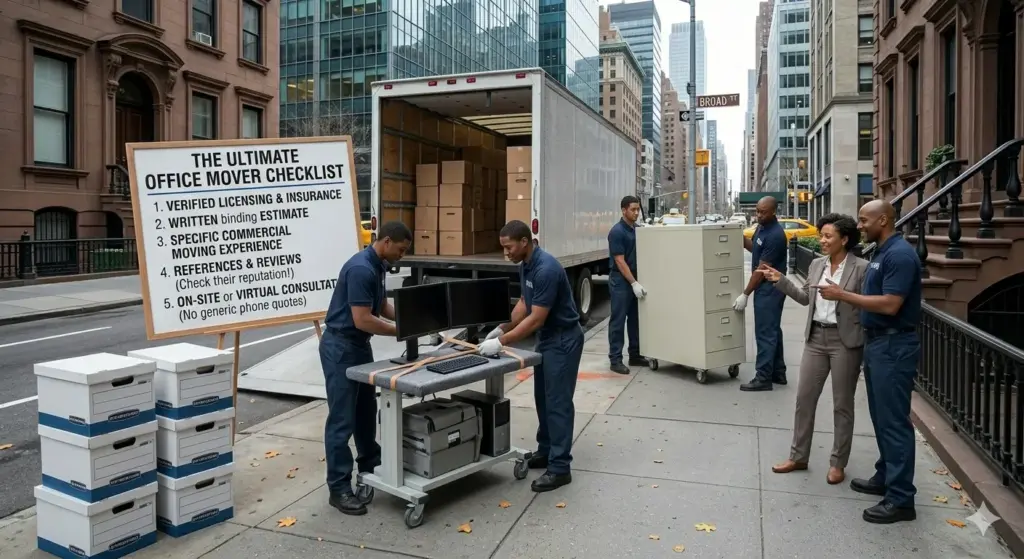
The Two-Stage Selection Process for Choosing Office Movers in NYC
Choosing office movers in New York has two distinct stages. Most businesses stop at Stage 1 and call whichever mover passes. That is how unplanned moving days happen.
|
Stage |
What It Covers |
|
Stage 1: Eligibility screening |
Verify the mover is legally allowed to operate. DCA license check, USDOT number, workers’ compensation certificate, general liability COI. This takes about 10 minutes and eliminates unlicensed operators. Every mover you contact should pass Stage 1 before you spend another minute on them. |
|
Stage 2: Operational fit assessment |
Determine whether the mover’s process protects your business on moving day. Fixed-scope vs. hourly pricing, COI filing procedure, freight elevator booking process, IT coordination capability, crew composition (in-house vs. subcontracted), and pre-move survey. This is where the real selection happens. |
Most articles about how to choose office movers cover Stage 1 and stop. This guide focuses on Stage 2, because that is where the difference between a move that finishes on time and one that costs your business a workday actually lives.
Stage 1: The 10-Minute Eligibility Check Every NYC Office Mover Must Pass
Run these checks before you request a quote. Any mover who cannot satisfy all four is not a candidate.
Check | How to Run It |
DCA license | Search the company name at nyc.gov/dca. Every commercial mover operating in New York City must hold a valid DCA license. A missing license means the company is operating illegally; skip them entirely. |
USDOT and MC number | Search at safer.fmcsa.dot.gov. Required for any mover that crosses state lines or carries commercial cargo for hire. Verify the company name on file matches the name you were quoted under. |
General liability COI | Request a sample Certificate of Insurance before the first conversation goes further. Confirm coverage meets your building’s minimums: $1 million per occurrence for most buildings, $2 million for Park Avenue co-ops and Class A towers. |
Workers’ compensation | Request the workers’ comp certificate alongside the liability COI. NYC building managers require both. A mover who produces liability only has an incomplete insurance picture. |
Dream Moving’s credentials: USDOT 3524817, MC 1244952, DCA licensed, full liability and workers’ compensation coverage. Documentation is provided before you sign anything.
Stage 2: The Six Operational Questions That Separate Good Office Movers from Great Ones
Once a mover passes Stage 1, the selection comes down to process. Ask every shortlisted mover the same six questions and compare answers side by side.
Question 1: Is the quote fixed scope or hourly?
This is the most important question in the selection process. An hourly quote gives you a number that has no ceiling. Every freight elevator delay, lobby disassembly, and parking problem extends the billable clock. A fixed project scope quote locks in one number against a defined inventory, crew, and timeline.
The right answer: ‘Fixed scope. If anything takes longer than planned due to building delays or access issues, that is our problem, not an addition to your invoice.’ Any answer involving hourly billing with caveats, caps, or estimates should be treated as hourly billing.
Question 2: Who contacts building management for the COI?
Every NYC commercial building requires a Certificate of Insurance before granting freight elevator access. The question is not whether the mover provides a COI. The question is whether they file it directly with building management and confirm approval in writing before moving day.
Mover Type | What They Actually Do |
Mover who provides the COI | Hands you a certificate and expects you to file it. If the building rejects it for a wrong named entity or insufficient coverage, that is your problem to solve the day before your move. |
Mover who files and confirms the COI | Contacts building management directly, confirms the named entities and coverage limits are correct, and sends you written approval confirmation. This is what protecting your move date actually looks like. |
Dream Moving files COIs with building management within 24 hours of booking confirmation and sends written approval to the client before the move date.
Question 3: Who books the freight elevator window?
A freight elevator window at a Midtown or Upper East Side commercial building is not a formality. It is a scheduled slot that buildings in Carnegie Hill and Lenox Hill restrict to weekday business hours. If the mover leaves this booking to you, you are managing a logistics task that belongs in their scope.
The right answer is that the mover contacts building management directly, reserves the window, and provides written confirmation of the reserved time at least 48 hours before your move date. Dream Moving handles freight elevator booking as a standard part of every commercial job.
Question 4: Are the crews in-house or subcontracted?
In-house crews are employees of the company you hired. Subcontracted crews are workers hired from a day labor pool or third-party agency for that specific job. The difference matters because training, accountability, and insurance coverage are all attached to the company, not the subcontractor.
Crew Type | What It Means for Your Move | Dream Moving |
In-house employees | Trained by the company you hired; covered under the company’s liability and workers’ comp; accountable to a supervisor who will be on your job | All Dream Moving commercial crews are in-house employees |
Subcontracted labor | Training varies; insurance coverage may be separate or absent; accountability chain is unclear if something goes wrong on moving day | Dream Moving does not subcontract commercial moving crews |
Question 5: How is IT equipment handled?
For most NYC offices, the IT scope is the highest-risk part of the move. Workstations disconnected without a labeled reconnect sequence, servers transported without anti-static protection, and rack-mounted equipment loaded without custom crating are the three most common sources of post-move downtime.
Ask any mover you are considering: ‘Is the disconnect and reconnect sequence confirmed with our IT contact before moving day, and is that coordination included in the quote or billed separately?’ A mover who cannot answer this question specifically does not have an IT process. They have a hope.
Question 6: What does the pre-move survey cover?
A pre-move survey is not just a furniture count. For a commercial office move in New York, it should cover freight elevator dimensions at both buildings, building move policy and hours, parking and DOT permit requirements, IT scope confirmation, non-allowable item identification, and floor plan mapping at the destination.
If a mover’s pre-move survey is a phone call asking how many desks you have, that mover has not done enough preparation to protect your move date.
The Office Mover Comparison Scorecard: How to Compare Three Quotes Side by Side?
Once you have answers to all six Stage 2 questions from each shortlisted mover, compare them in writing. This table gives you the framework.
Evaluation Criterion | Weak Answer | Strong Answer |
Quote structure | Hourly rate with a ‘rough estimate’ of total hours | Fixed project scope with a single confirmed number |
COI handling | ‘We provide a certificate’ or ‘you file it with your building’ | ‘We contact building management, file it, and send you written approval’ |
Freight elevator booking | ‘Let us know when you have confirmed the window’ | ‘We book the window directly and confirm it in writing 48 hours out’ |
Crew composition | ‘We work with experienced teams’ or no direct answer | ‘All crews are our in-house employees; no subcontracting’ |
IT coordination | ‘We can help with basic disconnection’ or ‘we move equipment carefully’ | ‘IT scope is confirmed with your IT contact before moving day and is included in the quote’ |
Pre-move survey | Phone call to count items; no site visit offered | On-site or video survey covering freight dimensions, building policy, IT scope, and floor plan |
Score each mover across these six criteria before you compare price. A fixed-scope mover at $4,500 who scores strong on all six is less expensive than an hourly mover at $3,800 who scores weak on three.
Red Flags That Rule Out an Office Mover in New York
These are the signals that indicate an office mover will cost you more than their quote on moving day.
Red Flag | What It Actually Means |
Quote given without a site survey or detailed inventory | The mover cannot accurately price your job without knowing your freight elevator dimensions, building access hours, and furniture complexity. A quote without a survey is a number that will change. |
COI issued but not filed; client expected to coordinate with building management | You are managing a logistics task that the mover should own. If the COI gets rejected by building management for a wrong named entity, your move date is at risk. |
Freight elevator booking left to the client | Buildings in Manhattan restrict elevator windows and require advance booking in writing. A mover who does not handle this booking has not done enough pre-move preparation. |
Vague answer about crew composition | If a mover cannot confirm that the crew is in-house employees, they are using subcontracted labor. That means unknown training, uncertain insurance, and limited accountability. |
Large cash deposit required before move date | Reputable commercial movers do not require large upfront cash payments. This is a financial red flag and occasionally a setup for a hostage goods situation. |
Hourly billing with no ceiling or written scope change process | Every delay becomes your cost. Building elevator waits, lobby furniture disassembly, and parking problems are all foreseeable in NYC and belong in the mover’s fixed scope, not on your invoice. |
When to Start Looking for Office Movers and What the Timeline Looks Like?
The selection process has a timeline that is not optional in New York. Buildings impose it through their freight elevator booking lead times and COI review requirements.
Weeks Before Move Date | Selection and Pre-Move Task |
8 to 12 weeks out | Start the selection process. IT-heavy moves, medical practice relocations, or buildings with strict co-op board approval processes need this lead time. Collect quotes from three DCA-licensed movers. |
6 to 8 weeks out | Complete Stage 1 eligibility checks and Stage 2 operational questioning on all shortlisted movers. Choose your mover and confirm booking. |
4 to 6 weeks out | Mover conducts pre-move survey; fixed-scope quote issued and signed; COI filed with building management; freight elevator window booked. |
2 to 3 weeks out | Written COI approval confirmed from building management; freight window confirmed in writing; IT scope agreed with your IT contact; floor plan for destination confirmed. |
48 hours out | Mover sends written move confirmation: scope, start time, crew size, freight window, parking plan. If any of this is missing at 48 hours, call immediately. |
Move day | Crew arrives before the freight window opens; floor runners and elevator pads installed; move executed within the confirmed scope. |
Peak season runs from May through September. Freight elevator windows in Class A buildings during those months are booked up to four weeks out. Starting the selection process at four weeks will limit your choices significantly.
How Dream Moving Handles Every Stage 2 Criterion?
Here is a direct answer to every Stage 2 question as Dream Moving would answer it for any commercial office move in New York City.
Stage 2 Question | Dream Moving’s Answer |
Is the quote fixed scope or hourly? | Fixed project scope. One number covers crew, truck, hours, COI, floor protection, and packing materials. If building delays extend the timeline, the scope number does not change. |
Who files the COI with building management? | Dream Moving contacts building management directly, files the certificate within 24 hours of booking confirmation, and sends written approval to the client before the move date. |
Who books the freight elevator window? | Dream Moving contacts building management directly, reserves the window, and provides written confirmation to the client at least 48 hours before the move date. |
Are crews in-house or subcontracted? | All crews are Dream Moving employees. No subcontracting on any commercial job. |
How is IT equipment handled? | IT scope is confirmed with the client’s IT contact at the quote stage. Disconnect/reconnect sequence is agreed before moving day. Cable labeling and custom crating for rack-mounted equipment are available. IT coordination is included in the project scope, not billed separately. |
What does the pre-move survey cover? | Freight elevator dimensions at both buildings, building move policy and hours, parking and DOT permit requirements, IT scope confirmation, non-allowable item identification, and floor plan mapping at the destination. |
Book a commercial move or request a written project-scope quote at dream-moving.com/moving-services/commercial-moving/ or call (212) 994-4941.
Frequently Asked Questions: How to Choose Office Movers?
These questions come from office managers, operations leads, and business owners comparing commercial movers in New York City.