

Narrow Hallways and Walk-Ups in NYC: How a Move Actually Works in 2026
- Home
- »
- Local Moving
- »
- Narrow Hallways and Walk-Ups in NYC: How a Move Actually Works in 2026
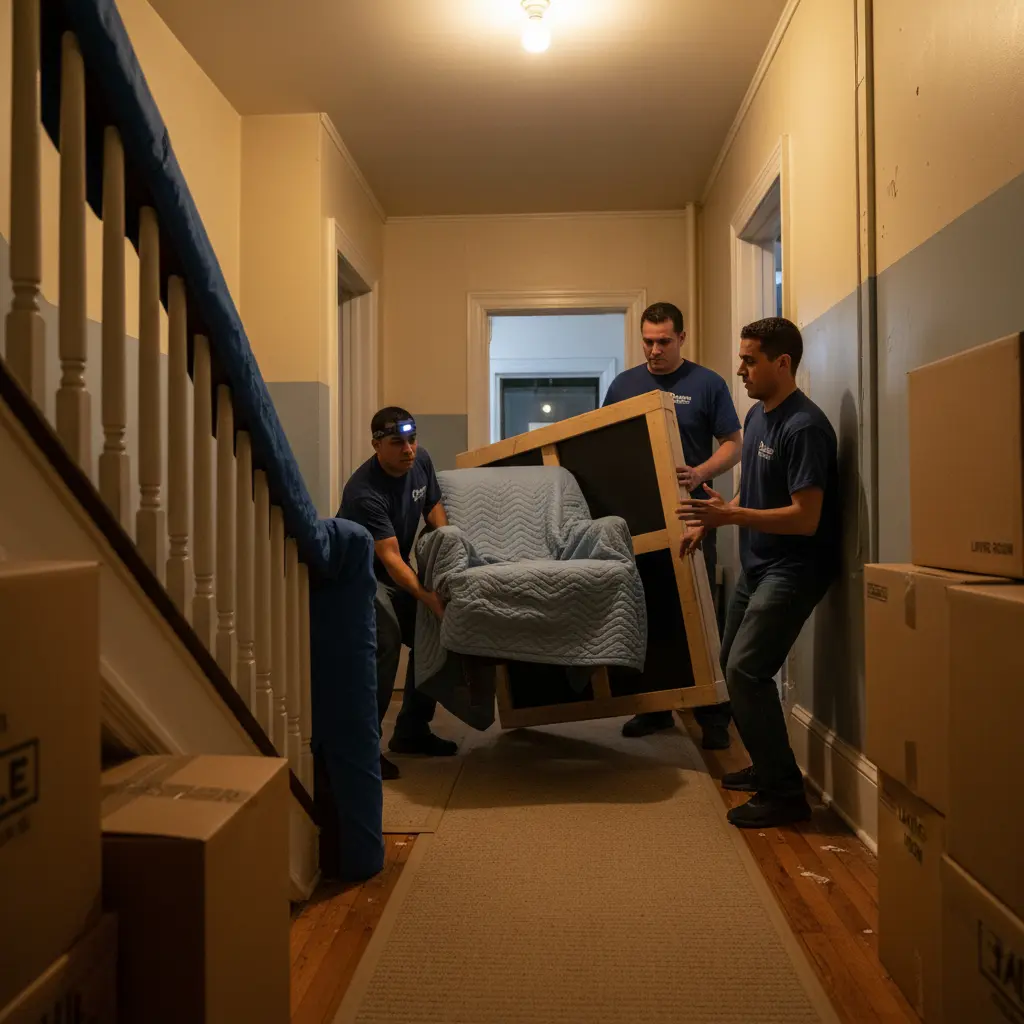
About 915,800 NYC housing units, roughly 25%, require at least one flight of stairs to reach the front door, according to the city’s 2021 Housing and Vacancy Survey. A walk-up or narrow-hallway building doesn’t rule out a move, but it does change how one is planned: measuring doorways and stairwells before move day, scaling the crew size for higher floors, and having a tactical plan for the rare piece that genuinely won’t turn a corner. This guide covers how that planning actually works.
How Common Are Walk-Up Buildings in NYC?
Roughly 915,800 units, 25% of the city’s housing stock, require stairs to reach the unit.
The 2021 NYC Housing and Vacancy Survey found that 915,800 units, about 25% of the city’s housing stock, require one or more flights of stairs to reach the unit. New York’s own Multiple Dwelling Law only began requiring a 3-foot minimum clear width for stairs and public halls in tenements built after April 18, 1912, which is exactly why older pre-war buildings can still have stairwells narrower than that, sometimes around 30 inches, and why measuring before move day matters more in NYC than almost anywhere else.
Does Walk-Up Prevalence Vary by Borough?
Brooklyn has the highest share of walk-up units at 33%; Staten Island has the lowest at 14%.
Borough | Units Requiring Stairs | Share of Borough’s Units |
|---|---|---|
Brooklyn | 360,100 | 33% |
Queens | 234,600 | 26% |
Bronx | 133,000 | 24% |
Manhattan | 163,000 | 18% |
Staten Island | 25,070 | 14% |
The same HPD survey breaks the citywide 915,800 figure down by borough, and the spread is wide: Brooklyn’s older, denser housing stock means a full third of its units require stairs, nearly double Staten Island’s 14%. Building age drives most of this gap directly: units built before 1947 require stairs at a 35% rate, compared to 11% for units built between 1947 and 1973, so a borough with more pre-war stock simply has more walk-ups, independent of anything else about the neighborhood.
How Does the Pre-Move Assessment Work?
An inch-by-inch measurement of doorways and stairwells, compared against the largest furniture piece’s diagonal.
Before move day, the largest pieces of furniture get measured on their diagonal and compared against the narrowest point in the path: doorways, stairwell landings, and hallway turns. If a sofa’s diagonal measurement is greater than the stairwell width, that’s the signal a tactical solution is needed rather than discovered on move day itself.
What Happens When Something Won’t Fit?
Three common scenarios each have a typical fix, from disassembly to, rarely, hoisting through a window.
Problem | Typical Fix |
|---|---|
A sofa won’t turn at the landing | Measure the diagonal against the stairwell width before move day; disassemble legs and cushions if the diagonal is too large |
A doorway is too narrow | Often needs only one or two more inches of clearance, removable by taking off door hinges or trim temporarily |
The stairwell is fully impassable | Trained manual hoisting through a window, only with building permission and when it can be done safely |
How Does Crew Size Change for a No-Elevator Move?
Walk-ups on the 4th or 5th floor typically get additional movers assigned to manage physical demand.
OSHA doesn’t set a hard weight limit for lifting or carrying; its own guidance points instead to factors that compound injury risk: how often an item is lifted, whether the lifter bends or twists, how high the object has to be raised, and how long the load is carried or held. Repeated stair climbs on a walk-up move hit several of these at once, frequency, lift height, and carry duration, which is exactly why walk-ups on the 4th floor or higher typically get additional crew assigned rather than asking the same small team to handle both the flat-ground and vertical portions of the job. More people also means shorter carry distances per person and more frequent rotation, which keeps any one mover from accumulating the fatigue that raises injury risk on a long walk-up job.
Which Furniture Pieces Actually Cause the Most Walk-Up Problems?
Sofas, mattresses on frames, and refrigerators cause the most stairwell problems, each for a different reason.
A standard sofa is the most common item that doesn’t turn a stairwell landing, since its length and depth combine into a diagonal measurement that can exceed a narrow landing’s width even when the sofa fits through the door at both ends. A queen or king mattress is usually flexible enough to bend around a tight turn, but a box spring is not, which is why box springs are the item most often disassembled, in this case meaning left behind or replaced with a split or folding version, rather than carried whole. A refrigerator is the heaviest single item in most apartments and has to stay upright for the compressor, which rules out some of the angled carrying techniques that work for a sofa. Each of these gets measured and planned for separately during a proper pre-move assessment rather than lumped into a single “big furniture” category.

Does a Walk-Up Building Cost More to Move?
No per-flight stair fees are added to the quote; the cost is built into the crew size assigned to the job.
No per-flight stair fees are added on top of the quote. Instead, the cost of extra labor for a higher walk-up is built into the crew size assigned to the job and confirmed as part of the flat fee before move day, not charged separately afterward.
What Does Hoisting Through a Window Actually Involve?
A rare, last-resort option requiring building permission, trained equipment, and favorable conditions.
Hoisting is genuinely rare, reserved for the small number of cases where a piece is too large for the stairwell at any reasonable angle and can’t be disassembled without damaging it. It requires the building’s explicit written permission, since equipment is typically set up on or near the building’s exterior and sometimes affects a public sidewalk below, favorable weather, and a crew trained specifically in the technique rather than general movers improvising with rope. This is assessed during the pre-move estimate whenever a piece’s measurements are borderline, not discovered as a surprise on move day itself.
Does the Time of Year Affect a Walk-Up Move’s Difficulty or Cost?
Peak summer demand means less flexibility if a walk-up move runs into an unexpected complication.
A walk-up move itself doesn’t cost more by season, but booking during StreetEasy’s identified peak, the second and third weeks of July specifically, means less crew flexibility if a walk-up move runs into a complication, a piece that needs disassembly on the spot, or a landing that requires a different carrying angle than planned. Booking a walk-up move outside that peak window gives a crew more room to solve a problem on the spot rather than rushing to the next job.
How Should You Prepare for a Walk-Up or Narrow-Hallway Move?
Measure your largest pieces, clear the path, and flag any item you suspect won’t fit before move day.
- Measure the diagonal of your largest furniture pieces against your narrowest doorway and stairwell landing
- Clear hallways and stairwells of anything that could obstruct the path
- Flag any piece you suspect won’t fit so it can be assessed before move day, not discovered mid-move
- Confirm with your building whether door hinges or trim can be temporarily removed if needed
- Ask your mover directly how crew size is scaled for your specific floor and stairwell width
- Confirm whether your building requires a Certificate of Insurance despite having no elevator
None of this preparation requires special tools or expertise on your end, just measurements taken before move day rather than assumptions carried over from a previous, different apartment. The single most useful thing a renter can do is measure early enough that a genuine problem piece still has time to be assessed and planned for, rather than discovered with the crew already standing in the stairwell.
Does a Walk-Up Building Still Need a Certificate of Insurance?
Often not for a true walk-up with no shared elevator, but check anyway since some co-ops require one regardless.
A building with no elevator at all usually has no freight reservation to coordinate, which removes one of the two most common reasons a Certificate of Insurance gets requested. Some co-op walk-ups still require one regardless of elevator access, as a general liability condition for anyone working in the building, so confirm this with management directly rather than assuming a walk-up automatically skips the paperwork.
How Does Dream Moving Handle Walk-Ups and Narrow Hallways?
Dream Moving measures, protects hallways, and scales crew size, all within one flat, all-inclusive rate.
Dream Moving (USDOT 3524817, MC 1244952) local moving crews measure doorways and stairwells in advance, protect hallways with floor runners and padding, and scale crew size for higher walk-ups, all within one flat, all-inclusive rate across Manhattan and the rest of New York City, where pre-war buildings make this a routine part of the job rather than an exception. For a smaller load in a difficult building, our small moves service is also worth considering, and readers can call (212) 994-4941 or contact Dream Moving online to have a building assessed before booking.
Frequently Asked Questions
Does Dream Moving charge extra for 5th-floor walk-ups?
Can a sofa be hoisted through a window if it doesn't fit through the stairwell?
What if a wardrobe or particleboard furniture piece can't be disassembled?
How do movers protect hallways during a walk-up move?
How common are walk-up buildings without an elevator in NYC?
Does a walk-up building still require a Certificate of Insurance?
Is it more expensive to move in an older, pre-war walk-up?
What items are most likely to need disassembly in a walk-up move?
Sources
NYC HPD, 2021 NYC Housing and Vacancy Survey, selected initial findings: https://www.nyc.gov/assets/hpd/downloads/pdfs/services/2021-nychvs-selected-initial-findings.pdf
OSHA, standard interpretation on manual material handling: http://www.osha.gov/laws-regs/standardinterpretations/2013-06-04-0
New York Multiple Dwelling Law, Section 234 (stairs and public halls): https://www.nysenate.gov/legislation/laws/MDW/234
StreetEasy, Renter Demand Index (when renter demand is highest): https://streeteasy.com/blog/when-renter-demand-is-highest/
Dream Moving: https://www.dream-moving.com/