

How to Prepare for Office Movers: What Your Team Needs to Do First
- Home
- »
- Commercial Moving
- »
- How to Prepare for Office Movers: What Your Team Needs to Do First
Six tasks fall to your team before office movers arrive: removing items the mover can’t transport, labeling furniture and boxes with a zone system, backing up data and documenting the IT setup, providing a floor plan for the new space, designating one on-site contact per location, and verifying the mover’s own license and insurance before signing anything. Everything else, Certificate of Insurance filing, freight elevator booking, and floor protection, is the mover’s job. Knowing exactly where that line sits is what keeps move day from stalling on a task nobody owned.
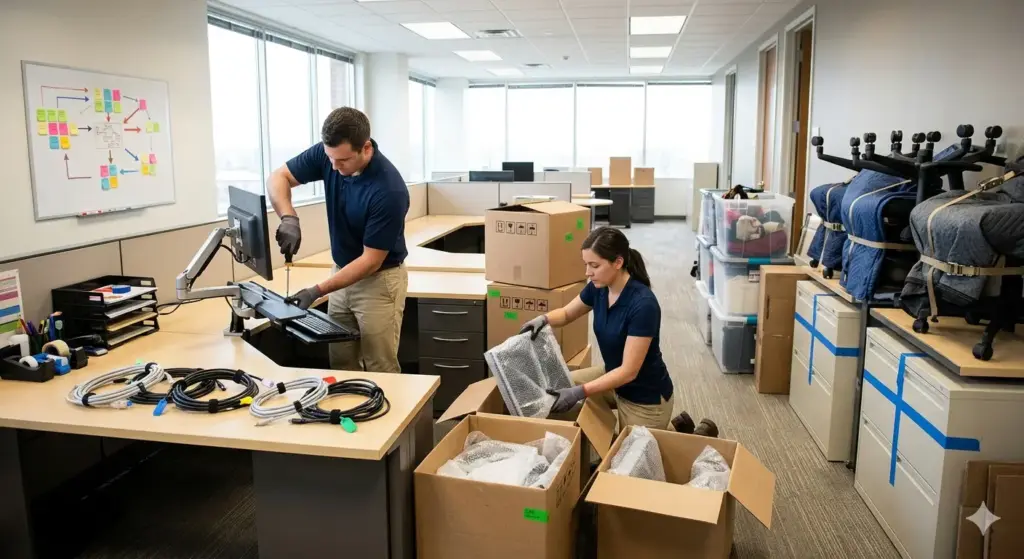
Who Handles What Before an Office Move?
Six tasks sit with your team; COI filing and building logistics sit with the mover.
Task | Who Handles It |
|---|---|
Removing non-allowable items | Your team, before the crew arrives |
Labeling furniture and boxes by zone | Your team, using the mover’s zone system |
Backing up data and documenting IT setup | Your team, in coordination with your IT vendor |
Providing a destination floor plan | Your team, shared with the mover before move day |
Designating an on-site contact | Your team, one person per location on move day |
Verifying the mover’s license and insurance | Your team, before signing a contract |
COI filing, freight elevator booking, floor protection | The moving company |
How Do You Verify the Mover Before Anything Else Starts?
Confirm NYSDOT authority, USDOT/MC numbers, and workers’ comp coverage before signing a contract.
Before any of the other five tasks matter, confirm the company you’re about to rely on actually holds a valid NYSDOT property authority and that its USDOT/MC numbers check out on FMCSA’s SAFER Company Snapshot system. Dream Moving’s own numbers, USDOT 3524817 and MC 1244952, are a working example of what should be checkable in a few minutes rather than taken on a sales rep’s word. It’s also worth confirming the mover carries workers’ compensation coverage for its crew, since New York requires virtually all employers with employees to carry it, and a mover that’s vague about this is a liability risk that can reach back to your business if someone is hurt on-site during the move.
What Should Be Removed Before the Crew Arrives?
Non-allowable items, personal workstation belongings, and anything not going to the new space.
Run through what office movers typically can’t move with your team before move day, since hazardous materials, certain regulated items, and undeclared high-value assets need separate handling. Employees should also clear personal items from their desks and the break room, and return any access cards or parking passes being deactivated at the old address.
Standard guidance for packing an office covers both: keep boxes light enough for one person to lift safely, never lift above shoulder height, and keep hallways clear so staged boxes do not become a trip hazard (CCOHS, Office Relocation).
How Do You Build a Zone Labeling System?
Map the new space into zones first, then label every box and piece of furniture to match.
Map the destination space into zones before anything gets labeled, then assign each department or area a zone code. A full walkthrough of the four-part labeling format that pairs with this step is worth reading in full if your office has more than a handful of workstations.
What Needs to Happen With IT Equipment Before Disconnect?
Back up data, photograph cable runs, and confirm who reconnects everything at the new space.
- Back up critical data before anything is disconnected
- Photograph and label cable runs at both ends before unplugging
- Bag accessories with their matching devices rather than boxing them separately
- Confirm the on-site reconnect contact and expected timing with your IT vendor in advance
Documenting current configurations and connections before anything is disconnected is what actually makes a fast, accurate reconnect possible at the new space. This step belongs to your IT vendor or internal IT staff, not the moving crew, which is generally staging and transporting equipment rather than reconfiguring it; agree on who owns each of these four steps before move day rather than assuming it’s covered.
Why Does the Mover Need a Floor Plan in Advance?
A floor plan lets the crew place furniture correctly the first time, without guessing on move day.
A floor plan showing where each zone lands in the new space lets the crew unload directly into position instead of staging everything and sorting it out later. Share it with your mover before move day, not when the truck arrives. Without one, furniture often gets placed by the crew’s best guess, which frequently needs to be rearranged again once department heads see the result, turning a single move into two rounds of furniture placement.

What Does the 48-Hour Pre-Move Checklist Cover?
A final confirmation pass: IT backups done, labeling complete, floor plan sent, and on-site contact assigned.
Two days out, confirm the basics are actually done rather than assumed: data backups complete, all boxes and furniture labeled, the floor plan sent to the mover, an on-site contact assigned for move day at each location, the freight elevator window reconfirmed in writing with both buildings, and access credentials ready for the new space. This is the point to catch a gap while there’s still time to fix it, not discover it when the truck is already outside.
A short written run-of-show for move day itself, crew arrival time, when packing needs to be finished, who’s on-site at each location and how to reach them, and when IT expects systems back online, gives everyone involved the same reference point instead of relying on memory of what was discussed weeks earlier. Printing a copy for the on-site contact at each location, rather than relying on an email they may not have open, is a small step that avoids a lot of avoidable back-and-forth on the day itself.
What Belongs on a Pre-Move Inventory Walkthrough?
Walking the space with the mover before the quote catches constraints a floor plan alone won’t show.
Beyond providing a floor plan, your team should walk the current space with the mover before the quote is finalized, pointing out anything that doesn’t show up on a standard inventory: a conference table too wide for the service elevator, a safe or specialty piece that needs extra crew, shelving that’s bolted to the wall and needs disassembly, or a server rack that has to stay powered until the last possible minute. This walkthrough is what the mover’s fixed-scope quote should actually be built from, and it’s far easier to flag these details in person during the site assessment than to describe them accurately over the phone.
It’s also the point to ask directly about the crew structure, whether the team handling your move is in-house or subcontracted, and whether they’ve handled a comparable office size and building type before. This isn’t information your team needs to act on directly, but having the answer on record before the move helps if anything needs to be escalated afterward. Take photos during this walkthrough too, of existing wear or damage to the space and of any item you’re flagging as fragile or high-value, since they’re useful reference points if a damage question comes up after the move.
What Should Happen to Keys, Access Cards, and Security Systems?
Deactivation and reissuing access credentials needs its own timeline, separate from the moving company’s schedule.
Building access, keycards, fobs, alarm codes, and any biometric access system, needs its own coordination separate from the mover’s schedule. Old-building access should be deactivated on a timeline that doesn’t lock out your own team mid-move, and new-building credentials need to be issued with enough lead time that staff aren’t standing outside a locked door on day one. This is squarely a task for your team or your building’s property manager, not the moving company, and it’s easy to overlook amid the furniture and IT planning, especially when the two buildings use different access vendors with their own separate lead times for provisioning new cards.
What Should Employees Know Before Move Day?
A short written notice covering what to pack, what to leave, and where to report avoids dozens of individual questions.
A short written notice to staff, sent a week or so before the move, covering what they’re responsible for packing themselves, what the mover handles, where to report on move day, and when systems are expected to be back online, prevents the on-site contact from fielding the same handful of questions individually from every employee. This is a small step that pays off disproportionately on a move with more than a dozen or so staff, and it’s worth repeating a shorter version of the same notice the day before, since the first one tends to get buried in email by move week.
How Does Dream Moving Support This Preparation?
Dream Moving shares the zone labeling system and confirms the floor plan and IT handoff before move day.
Dream Moving (USDOT 3524817, MC 1244952) provides the zone labeling system as part of booking a commercial move and confirms the floor plan and IT reconnect handoff before move day, for offices across Westchester and the rest of the service area. Teams preparing for an upcoming move can contact Dream Moving at (212) 994-4941 for the full preparation checklist.
Frequently Asked Questions: How to Prepare for Office Movers?
How do I prepare for office movers in NYC?
What should employees do before office movers arrive?
How should I label boxes for an office move?
What should I do with IT equipment before office movers arrive?
Who files the Certificate of Insurance for an office move?
How do I verify an office mover's license before hiring them?
What should happen to building access and keycards during an office move?
Should my team walk the space with the mover before the quote is finalized?
Sources
Certificate of insurance, definition (IRMI): https://www.irmi.com/term/insurance-definitions/certificate-of-insurance
Office Relocation safety guidance, CCOHS: https://www.ccohs.ca/oshanswers/hsprograms/office_relocation.html
NYSDOT Authority to Transport Property (Except Household Goods): https://nyc-business.nyc.gov/nycbusiness/description/authority-to-transport-property-except-household-goods
FMCSA SAFER Company Snapshot (USDOT lookup): https://safer.fmcsa.dot.gov/
Workers’ Compensation Coverage Requirements, NY Workers’ Compensation Board: https://www.wcb.ny.gov/content/main/coverage-requirements-wc/wc-coverage-required.jsp
Dream Moving: https://www.dream-moving.com/