

How to Choose Office Movers? The Decision Framework NYC Businesses Actually Need
- Home
- »
- Commercial Moving
- »
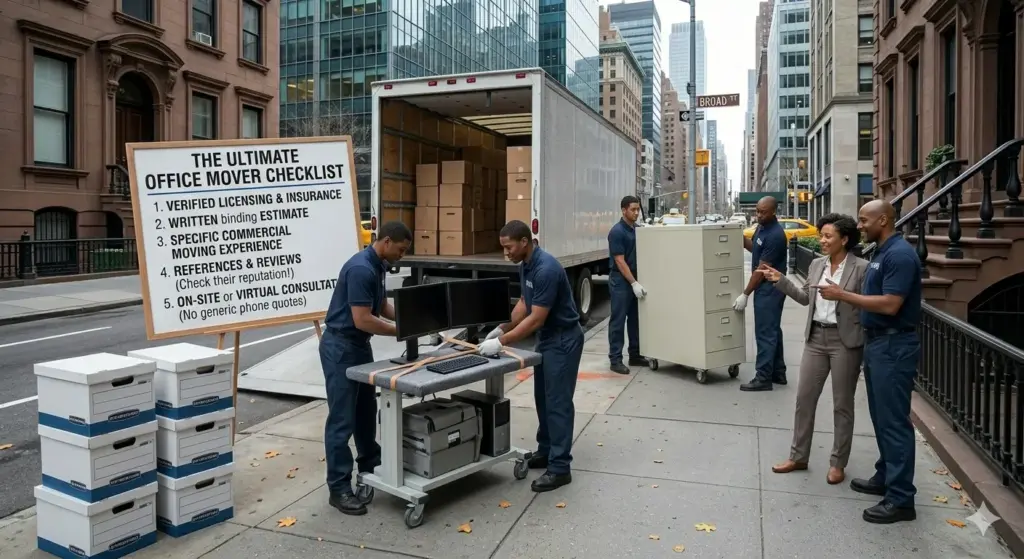
- How to Choose Office Movers: A Two-Stage Decision Process
Choosing an office mover comes down to two stages: a quick eligibility check that rules out unlicensed or uninsured companies, and six operational questions that separate a mover who will handle your specific building well from one who will struggle with it. The eligibility check takes about ten minutes per company. The six questions below take a bit longer but are what actually predict whether move day goes smoothly.
What’s the Two-Stage Process for Choosing an Office Mover?
Stage one rules out unqualified movers; stage two compares the qualified ones on how they’ll actually run your move.
Stage one is a pass/fail eligibility check: licensing, federal registration, and active insurance. Any company that fails stage one should be removed from consideration regardless of price. Stage two is a comparison across the companies that passed, using six operational questions that reveal how each one will actually handle your specific building and business.
The active-insurance check specifically means a Certificate of Insurance, a standard document confirming active coverage that a third party like a building can verify (IRMI, certificate of insurance), not just a mover’s verbal assurance that they’re covered.
What Does the Eligibility Check Cover?
Four checks: state transport authority, federal USDOT/MC numbers, active insurance, and workers’ comp coverage.
Check | What to Look For |
|---|---|
NYSDOT property authority | An active Authority to Transport Property number, separate from household goods authority |
USDOT / MC numbers | Checkable through FMCSA’s SAFER system; a legitimate carrier should hand these over without hesitation |
Active insurance | A working Certificate of Insurance process the mover can describe without hesitation |
Workers’ compensation coverage | Required of virtually every New York employer with employees, crews included |
The NYSDOT Authority to Transport Property is the state permit specifically covering commercial and business goods, separate from the household goods authority used for residential moves. As a concrete example of what a passing company looks like: Dream Moving operates under USDOT 3524817 and MC 1244952, both independently verifiable through FMCSA’s SAFER Company Snapshot system rather than taken on faith from a quote sheet. The workers’ compensation check matters separately from the COI: New York requires virtually all employers with employees, a moving crew included, to carry this coverage (NY Workers’ Compensation Board, coverage requirements), and a company that’s vague about it is taking on liability that can reach back to the business that hired them if a crew member is injured on-site.
What Six Questions Separate Good Movers From Great Ones?
How quotes are priced, who handles building logistics, and how IT equipment is managed.
Question | What a Strong Answer Sounds Like |
|---|---|
Is the quote fixed-scope or hourly? | Fixed-scope, priced from an actual site assessment |
Who contacts building management for the COI? | The mover, as a standard part of booking, not left to you |
Who books the freight elevator window? | The mover, confirmed directly with both buildings |
Are crews in-house or subcontracted? | In-house, or subcontractors the mover can name and vouch for directly |
How is IT equipment handled? | Staged by the mover, reconnected by a named specialist vendor |
What does the pre-move survey cover? | A specific walk-through of both spaces, not a phone guess |

How Do You Compare Three Quotes Side by Side?
Score each mover on the same six operational questions, not just the bottom-line price.
Put the six operational questions above into a simple scorecard and fill in each mover’s actual answer, not just whether they quoted a number. The lowest bottom-line price from a company that can’t answer who’s booking the freight elevator is a false economy if it means your move day stalls waiting on a building requirement nobody confirmed.
It’s also worth asking each company for two or three references from a job of comparable size and building type, not just a star rating. A company that’s hesitant to name a single past commercial client, even one it can anonymize, is a weaker bet than a high average review score on its own would suggest, since reviews rarely capture how a company handled a freight elevator dispute or an IT reconnection delay.
What Red Flags Rule Out an Office Mover Immediately?
No verifiable authority number, no COI process, and only hourly pricing with no site assessment offered.
The eligibility check above is also the fastest way to catch a mover that will later turn out to have a gap in what it’s actually willing to transport. Run through what office movers typically can’t move during the same conversation, so there are no surprises once the truck is booked.
- Can’t provide a NYSDOT authority number or it doesn’t check out
- No clear process for filing a Certificate of Insurance
- Only offers hourly pricing with no site assessment or written scope
- Can’t say who’s responsible for booking the freight elevator window
- Vague or evasive answers about whether crews are in-house or subcontracted
- Can’t or won’t provide USDOT/MC numbers for independent verification
What Documents Should a Mover Hand You at Booking?
A written scope, a signed inventory, and valuation terms, not a verbal agreement and a handshake.
- A written, fixed-scope estimate itemizing what’s included and what’s billed separately
- A signed inventory list reflecting the actual site assessment, not a generic template
- The valuation option selected for the move: released value protection at the standard capped rate, or full value protection if declared and paid for
- Written confirmation of the freight elevator window once it’s booked with the building, not just a verbal “we’ll handle it”
- The Certificate of Insurance, or written confirmation of when it will be filed and with whom
A mover that provides all five of these without being asked twice is demonstrating the same operational discipline the six-question stage is trying to measure. A mover that’s reluctant to put any of them in writing before a deposit changes hands is worth a second look, regardless of how competitive the quoted price is. Keep copies of all five documents until well after the move is complete and the final invoice is paid, since they’re the first thing to reference if a dispute comes up over scope, damage, or a missed deadline.
Should You Book Directly With a Mover or Through a Broker?
A broker assigns your job to a mover you may never get to vet yourself.
A moving broker arranges a job and assigns it to an actual mover, sometimes one the broker hasn’t worked with before and the customer never gets to evaluate directly. For a commercial job, where building access, insurance, and freight elevator coordination all depend on knowing exactly who’s showing up, booking directly with a mover removes that layer of uncertainty. Asking plainly, “will you be doing this move yourselves, or assigning it to another company,” is a fair question at the quote stage, and belongs in the same conversation as the two-stage check above. A company that hedges on this question, or that quotes a number significantly below every other bid you’ve collected, is worth running through the eligibility check a second time before signing anything.
How Should a Business of a Different Size Weight This Checklist?
A five-person office and a 150-person company both run the same two stages, just at different stakes.
The two-stage process doesn’t change based on company size, but what’s riding on getting it right does. A five-person office that picks the wrong mover loses a day, maybe two, of productivity and absorbs a bad experience. A 150-person company with a floor of IT infrastructure, confidential client files, and a hard lease deadline is exposed to a meaningfully larger cost if a freight elevator window gets missed or a specialist vendor isn’t coordinated in time. Larger offices should weight the operational-questions stage more heavily, specifically the IT handling and crew-structure questions, since those are the two most likely to cause a costly delay at scale rather than just an inconvenience.
Smaller offices, meanwhile, sometimes skip the eligibility check entirely on the assumption that a small job doesn’t need the same scrutiny as a large one. It does. An unlicensed or uninsured mover is just as much of a liability risk moving five desks as five hundred; the dollar exposure is smaller, but the legal exposure, an uninsured crew member getting hurt in your building, for instance, isn’t proportional to job size.
When Should You Start Looking for Office Movers?
Start roughly six to eight weeks out; add more lead time for IT-heavy or medical office moves.
Six to eight weeks gives enough time to run both stages of this process, get a real site assessment, and book a freight elevator window before the building’s schedule fills up. Add more lead time for moves with heavy IT infrastructure or medical equipment, both of which usually need extra coordination, and for any move with DEA-regulated medications or other specialist-transport items, which can need four or more weeks of lead time on their own.
How Does Dream Moving Handle Every Stage-Two Criterion?
Fixed-scope pricing, COI filing, freight elevator booking, and IT staging are handled as standard, not add-ons.
Dream Moving (USDOT 3524817, MC 1244952) answers all six operational questions the same way for every commercial move: fixed-scope pricing from a real site assessment, the mover handles COI filing and freight elevator booking directly, and IT equipment is staged for a named specialist vendor’s reconnect. This applies the same way across Long Island and the five boroughs. Businesses running through this checklist can contact Dream Moving at (212) 994-4941 directly with the six questions above.
Frequently Asked Questions: How to Choose Office Movers?
These questions come from office managers, operations leads, and business owners comparing commercial movers in New York City.
How do I choose office movers in NYC?
What's the most important question to ask office movers?
Should I get three quotes when choosing office movers?
How far in advance should I book office movers in NYC?
What credentials should office movers have in New York City?
Is it better to choose a mover directly or go through a broker?
What documents should a mover provide before a deposit is paid?
Does the two-stage checklist apply differently to a small office versus a large one?
Sources
FMCSA SAFER Company Snapshot (USDOT lookup): https://safer.fmcsa.dot.gov/
NYSDOT Authority to Transport Property (Except Household Goods): https://nyc-business.nyc.gov/nycbusiness/description/authority-to-transport-property-except-household-goods
Certificate of insurance, definition (IRMI): https://www.irmi.com/term/insurance-definitions/certificate-of-insurance
Workers’ Compensation Coverage Requirements, NY Workers’ Compensation Board: https://www.wcb.ny.gov/content/main/coverage-requirements-wc/wc-coverage-required.jsp
Dream Moving: https://www.dream-moving.com/