

What Are Good Office Movers in Upper East Side NYC?
- Home
- »
- Commercial Moving
- »
- Office Movers on the Upper East Side: What Makes These Moves Different in 2026
Upper East Side office moves run into two problems more often than the rest of Manhattan: older buildings with narrow or limited freight elevators, and co-op and condo boards with strict Certificate of Insurance requirements. A mover that handles standard Midtown high-rises well does not automatically handle a pre-war building on Park or Fifth Avenue the same way. The checklist below covers what to confirm before booking, where the UES differs enough from the rest of Manhattan to matter, and how to verify a mover’s licensing before it becomes a move-day problem.
A No-Nonsense Guide for Businesses!
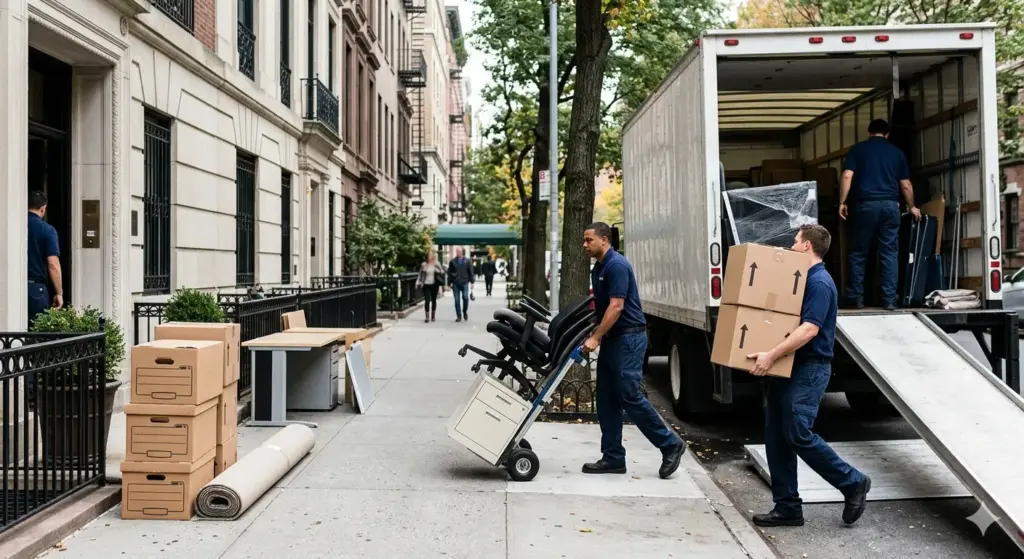
Why Is the Upper East Side a Harder Office Move Than Most of Manhattan?
Older building stock means narrower elevators and stricter, more varied building insurance rules.
The neighborhood’s building stock skews older than Midtown or Downtown, with many pre-war co-ops and condos converted to medical and professional office use. That means freight elevator dimensions vary more from building to building, and management companies tend to enforce Certificate of Insurance and additional-insured rules more strictly than a newer commercial tower would. A co-op board, unlike a commercial landlord managing dozens of tenants, often has only one or two buildings to worry about, and its managing agent tends to apply the same scrutiny to a moving company that it applies to a renovation contractor.
Service entrances on these buildings often sit below grade or around the back of the building, reached by a narrower corridor than the lobby entrance, which can mean a different staging plan than a newer tower where the loading dock and freight elevator sit side by side. Door widths at the destination suite can also be original to a pre-war layout, narrower than modern commercial doors, which matters for anything wider than a standard desk, like a conference table or a server rack cabinet. None of this is unworkable, but it has to be measured during the site assessment rather than assumed from a building’s address alone.
What Should You Confirm Before Booking?
Six checks catch the issues that are specific to older UES building stock.
What to Confirm | Why It Matters on the UES |
|---|---|
NYSDOT property authority + active COI | Pre-war co-ops and condos on the UES are strict about building access without both on file |
USDOT / MC number verified on SAFER | Confirms the mover’s federal registration is active, not just claimed on a flyer or a website |
Freight elevator dimensions | Many UES buildings predate modern freight elevators; a desk or cubicle panel that doesn’t fit changes the whole plan |
Fixed-scope, not hourly, quote | Narrow elevators and longer carries can inflate an hourly bill fast; a fixed quote prices that in up front |
After-hours or weekend availability | Many UES buildings restrict freight elevator use to specific windows, often outside standard business hours |
Medical or professional practice experience | The UES has a high concentration of medical offices, which need HIPAA-aware handling of files and equipment |
How Do You Confirm a Mover’s Licensing Before Booking?
Ask for the NYSDOT authority and USDOT/MC numbers, then check them against the state and federal databases directly.
A company working UES buildings needs the same New York State property authority any commercial mover needs, issued by NYSDOT, plus a valid USDOT and MC number checkable through FMCSA’s SAFER Company Snapshot system. As a concrete example of what that looks like in practice, Dream Moving’s own authority runs under USDOT 3524817 and MC 1244952, numbers that can be verified independently rather than taken on faith. For a co-op board that already vets every contractor who touches the building, a mover that volunteers this information upfront, rather than waiting to be asked, tends to clear the board’s own approval process faster.
What Does a COI Requirement Actually Look Like Here?
Most UES buildings require the COI filed before move day, not just issued, with the management company named exactly.
The same Certificate of Insurance rules that apply across NYC apply here, but UES co-op and condo boards tend to enforce the certificate holder name and filing deadline more strictly than a commercial landlord would. A certificate of insurance is formally a document providing evidence that specific types and amounts of coverage have been purchased (IRMI, certificate of insurance), and the managing agent or board is typically named on it as an additional insured, a party added to the policy so it shares in the coverage. Confirm the exact legal name the building wants on the certificate, and file it several business days ahead rather than the day before; a board that meets monthly may not be able to approve a corrected certificate on short notice the way a commercial property manager with daily office hours can.
How Does Fixed-Scope Pricing Protect a UES Move?
A fixed-scope quote prices in the extra time a narrow elevator or long carry adds, rather than billing it hourly.
An hourly quote for a UES move is riskier than for a move in a building with a standard modern freight elevator, since a narrow or slow elevator adds real time that an hourly rate bills directly to you. A fixed-scope quote, based on a site assessment that accounts for the specific building’s elevator and access constraints, removes that variable from your budget. This matters more on the UES specifically because the variance between buildings, a 1920s co-op with a single slow elevator versus a 1990s condo tower with two modern ones, is wider than almost anywhere else in Manhattan, which makes a generic, unassessed quote a weaker starting point here than elsewhere.

What Do UES Freight Elevator Windows Typically Look Like?
Shorter windows and more building-specific rules than a standard Midtown commercial tower.
Where a large Midtown office tower might offer several freight elevator banks and a generous multi-hour window, a UES co-op or condo often has just one freight elevator shared with residents and other commercial tenants, which can mean a shorter reserved block, sometimes two hours instead of four. Some buildings also restrict freight use to very specific times, like before 9am or after 6pm on weekdays, to avoid conflicting with resident move-ins or deliveries. Reserving this window early, and reconfirming it a few days before the move, matters more here than in a newer building with more elevator capacity to spare.
Buildings near one of the neighborhood’s major hospital campuses sometimes add a further wrinkle: loading areas that double as ambulance or emergency vehicle access, which a building may restrict further during certain hours. Flagging this during the site assessment, rather than discovering it on move day, avoids a truck being asked to move mid-load.
Does the Mover Handle Medical and Professional Offices?
Medical practices need movers experienced with patient files and sensitive equipment, not just furniture.
The UES has a dense concentration of medical and professional offices, driven in large part by the neighborhood’s proximity to several major hospital systems. Moving a practice involves patient files that need chain-of-custody handling and medical equipment that may need specific transport conditions, which is different from a standard office move with desks and filing cabinets. Ask directly whether the mover has handled a comparable medical or professional office move before booking.
HIPAA compliance guidance for healthcare relocations calls for a documented chain of custody for every container, device, or media item that may hold patient information, logging who handled it and when, locked or tamper-evident transport containers, and encrypted handling of any electronic health records during the move, not just a general promise to be careful (Accountable, HIPAA compliance during a healthcare office move). That same guidance also recommends executing a business associate agreement with the mover before work begins, since a moving company handling PHI-containing boxes or devices is itself a business associate under HIPAA, something many practices overlook until a compliance review flags it after the fact.
What About Insurance for the Move Itself, Not Just Building Access?
Workers’ compensation coverage for the crew matters as much as the COI the building asks for.
Separate from the Certificate of Insurance a building requires, New York requires virtually all employers with employees, a moving company’s own crew included, to carry workers’ compensation coverage. For a medical or professional office specifically, where a mishandled piece of equipment or an injured crew member could mean a liability claim reaching back to the practice itself, confirming the mover carries this coverage is worth the extra question even though it’s not the certificate the building asks to see. A mover that relies on uninsured day labor for a UES job, rather than a covered in-house or vetted subcontracted crew, shifts that risk onto whichever party ends up holding the building’s goodwill afterward, typically the tenant who hired the mover in the first place.
How Does Dream Moving Handle Upper East Side Commercial Moves?
Dream Moving books freight elevator windows directly with UES building management and files the COI in advance.
Dream Moving (USDOT 3524817, MC 1244952) runs commercial moves across the Upper East Side and the rest of Manhattan, confirming freight elevator dimensions and building insurance requirements during the site assessment rather than on move day. Businesses with an older or unusually configured building can contact Dream Moving at (212) 994-4941 to confirm access details before booking.
Frequently Asked Questions: Upper East Side Commercial Movers
These questions come directly from business owners, office managers, and practice administrators looking for commercial movers in the Upper East Side.
What makes Upper East Side office movers different from other Manhattan movers?
Do Upper East Side buildings really require a COI for commercial movers?
Can a mover handle a medical or professional practice move on the UES?
Why does a fixed-scope quote matter more for a UES move?
How far in advance should I book a commercial mover on the Upper East Side?
How can I verify a mover's license before booking a UES office move?
Are UES freight elevator windows shorter than in other parts of Manhattan?
Often, yes. Many UES co-ops and condos have a single freight elevator shared with residents, which can mean a shorter reserved block than a large commercial tower with multiple freight banks. Confirm the exact window length with the building during the site assessment.
Sources
Certificate of insurance, definition (IRMI): https://www.irmi.com/term/insurance-definitions/certificate-of-insurance
NYSDOT Authority to Transport Property (Except Household Goods): https://nyc-business.nyc.gov/nycbusiness/description/authority-to-transport-property-except-household-goods
FMCSA SAFER Company Snapshot (USDOT lookup): https://safer.fmcsa.dot.gov/
How to stay HIPAA compliant during a healthcare office move, Accountable: https://www.accountablehq.com/post/how-to-stay-hipaa-compliant-during-a-healthcare-office-move
Workers’ Compensation Coverage Requirements, NY Workers’ Compensation Board: https://www.wcb.ny.gov/content/main/coverage-requirements-wc/wc-coverage-required.jsp
Dream Moving: https://www.dream-moving.com/