

COI for NYC Moves: What It Is and Why Your Building Requires It?
- Home
- »
- Local Moving
- »
- COI for NYC moves: What is it and why does your building require it?
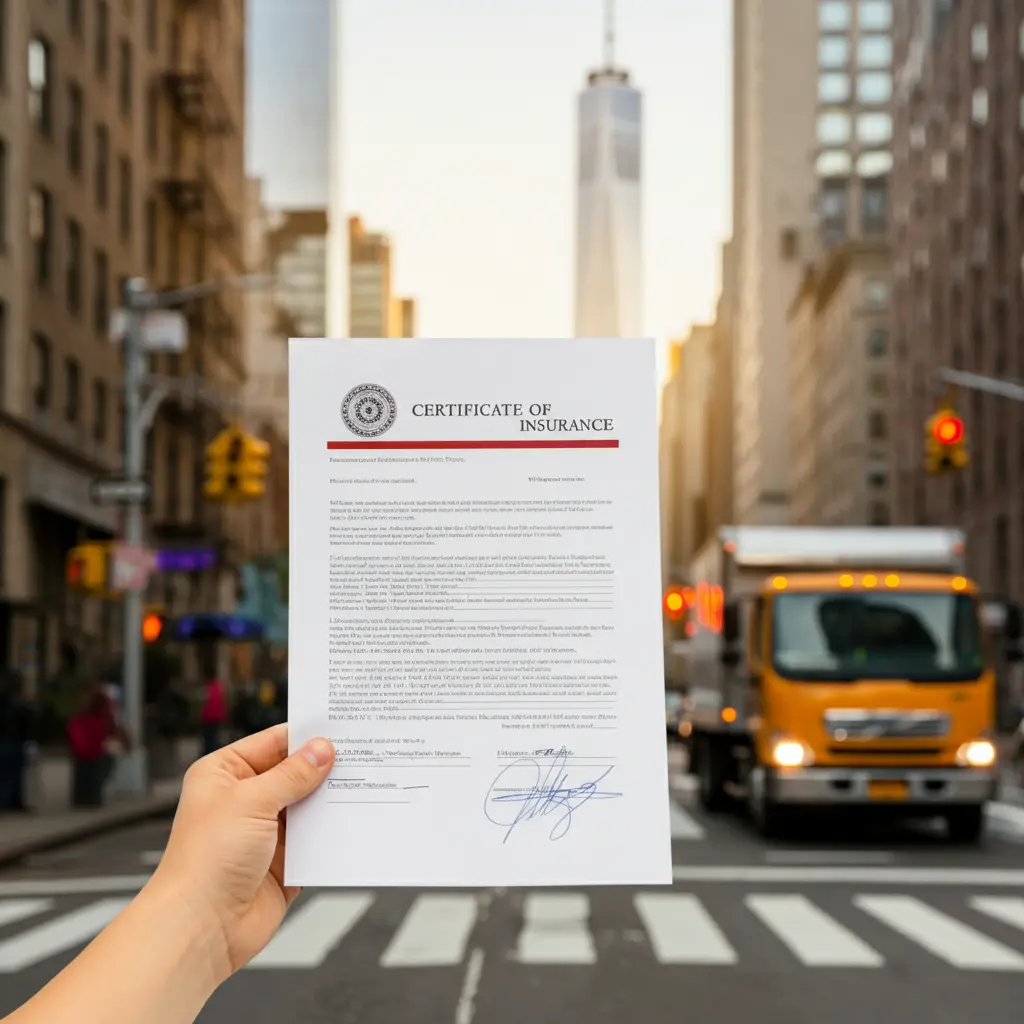
A Certificate of Insurance, or COI, is a one-page document that proves a moving company carries active liability insurance. It is built on the ACORD 25 form, the standard template used across the insurance industry. Most New York City apartment buildings, co-ops, and condos will not let a moving crew past the lobby without one on file, and the certificate usually has to name the building as an additional insured for the specific move date. Processing can take anywhere from the same day to about a week, so requesting it early is the simplest way to keep a move on schedule.
What Is a Certificate of Insurance (COI)?
A COI is a short summary of an insurance policy, not the policy itself. The International Risk Management Institute defines a certificate of insurance as a document providing evidence that certain insurance coverages and limits have been purchased by the party required to furnish it.
For a moving company, that document is almost always the ACORD 25 form, an industry-standard template that lists the insurer, the policy number, the coverage types, and the dates each policy is active. The certificate itself carries no legal force of its own. It only reports what the underlying policy said on the day it was issued, which is why a stale or mismatched COI gets rejected even when the company’s actual coverage is fine.
Why Do NYC Buildings Require a COI Before Moving Day?
A COI shifts responsibility for move-day damage onto the mover’s insurer instead of the building’s. New York co-op and condo boards carry master policies that cover the building’s common areas, and a claim against that policy raises premiums for every owner, not just the person who moved.
Insurance brokers who work with New York boards report that liability minimums have been climbing: many buildings that once accepted $500,000 in coverage now ask for $1 million, and some co-ops layer a $2 million to $3 million umbrella policy on top of that (Habitat, 2024). Requiring a COI from every mover lets the building point to that mover’s policy first if something gets damaged, rather than its own.
A COI also works as a basic screen. A company that cannot produce one on request usually does not carry active general liability insurance at all, which is one of the simplest red flags to check before you book.
What Information Has to Appear on a Moving COI?
A compliant COI names the insured mover, the certificate holder, the limit, and the move date.
Field | What It Shows | Why Buildings Check It |
|---|---|---|
Insured party | The moving company’s legal name, exactly as licensed | Must match the company you actually hired, not a subcontractor |
Certificate holder | Your building’s management company or board, by exact legal name | A name that does not match exactly is the top rejection reason |
General liability limit | Usually $1 million per occurrence and $2 million aggregate | Confirms the mover’s coverage meets the building’s stated minimum |
Additional insured endorsement | States that the building is added to the policy for the move date | Without it, the building has no direct claim on the mover’s policy |
Policy period | Effective and expiration dates of the underlying policy | Must cover the actual move date |
Description of operations | States the specific move date and address | A generic COI without this is routinely rejected |
How Much Liability Coverage Do NYC Buildings Typically Require?
Most NYC buildings ask for at least $1 million per occurrence in general liability coverage.
Brokers quoted by Habitat, the trade publication covering New York co-op and condo boards, describe $1 million in liability coverage as a common baseline today, with a $2 million to $3 million umbrella layered on top at some buildings (Habitat, 2024). Pre-war co-ops and larger buildings with freight elevators tend to sit at the higher end of that range, a pattern common in Astoria’s older co-op buildings.
A separate charge sometimes gets confused with the COI: a refundable move deposit, usually $500 to $1,000, collected directly by the building and returned after the move if nothing gets damaged. The deposit and the COI serve different purposes and are handled by different parties, so confirm both requirements with your building rather than assuming one covers the other.
How Long Does It Take to Get a COI?
Turnaround ranges from same day to about a week, depending on the carrier and the building.
Scenario | Typical Turnaround | What Causes the Difference |
|---|---|---|
Standard request to the mover’s existing carrier | Same day to 2 business days | Most common scenario; no custom wording needed |
Building requires a specific carrier or higher limits | 3 to 5 business days | Requires a custom endorsement rather than a standard template |
Co-op requires exact management-entity wording | Add 1 to 2 days if corrections are needed | The certificate holder name must match the building’s legal entity precisely |
Weekend or holiday request | Resumes the next business day | Most carriers process requests only Monday through Friday |
The practical rule most brokers and moving companies converge on: request your building’s COI requirements at least five business days before the move, and ten if the building names a specific carrier or an unusual limit. Asking on the day you book, rather than days later, does more to prevent a delay than anything else in this process.

What Causes a COI to Get Rejected on Move Day?
The top rejection reason is a certificate holder name that does not match the building exactly.
- Certificate holder name does not exactly match the building’s management entity
- Coverage limit falls below the building’s stated minimum
- Policy period does not cover the actual move date
- Additional insured endorsement is missing or not specific to the move
- The COI arrives after the building’s deadline, usually 24 to 48 hours before move day
If a COI is rejected or missing entirely, building staff can deny the crew access to the elevator and service entrance until a corrected certificate is accepted. A minor error, like a misspelled certificate holder name, can sometimes be fixed the same day. A COI that was never requested in the first place is harder to fix on short notice and often means rescheduling, since many buildings require 24 to 48 hours of advance notice for any move.
How to Verify a Mover’s COI Before Move Day
Check the COI yourself a few days before move day, not when the crew is already at the door.
- Confirm the insured party name matches the moving company’s legal name, not a similar-sounding name
- Confirm the certificate holder field lists your specific building, not a generic or different address
- Confirm the general liability limit meets or exceeds your building’s stated minimum
- Confirm the policy period covers your actual move date
- If anything looks off, call the insurance company listed on the COI directly, using the number on the document itself, not one the mover gives you
COI vs. USDOT Registration: What Each One Proves
A COI and a USDOT number prove two different things, and neither substitutes for the other.
Term | What It Confirms | How to Check It |
|---|---|---|
USDOT number | The company is registered as a licensed motor carrier with the FMCSA | Look it up through FMCSA’s SAFER system |
General liability insurance | The underlying policy that covers property damage and injury claims | Confirmed indirectly, through the COI |
Certificate of Insurance | A point-in-time proof the policy is active and the building is named as additional insured | Request it directly from the mover and check it against the field checklist above |
A company can have an active USDOT number without adequate insurance, and the reverse is also possible, though a legitimate mover usually has both. Checking the USDOT number through FMCSA’s SAFER system confirms the company is a registered carrier. Checking the COI confirms insurance specific to your move and your building.
How Dream Moving Handles the COI Process
Dream Moving requests and files the COI for every local NYC move at no extra charge.
Dream Moving (USDOT 3524817, MC 1244952) asks for the building’s COI requirements at the time of booking, whether that is a forwarded email from management or the management company’s direct contact information. The team contacts the building to confirm the exact wording needed, then has the certificate issued and sent, typically within the standard turnaround window described above. Buildings with an unusual carrier or wording requirement can contact Dream Moving directly to confirm the details before move day.
Frequently Asked Questions about COI for NYC moves
What is a Certificate of Insurance (COI) for an NYC move?
Why does my NYC building require a COI?
How much does a COI cost?
What is the most common reason a COI gets rejected?
Is a USDOT number the same thing as a COI?
Can I use my own renter's insurance instead of a mover's COI?
Sources
Certificate of insurance, definition: https://www.irmi.com/term/insurance-definitions/certificate-of-insurance
Protect Your Building: Mandating Insurance for Shareholders and Unit-Owners, Habitat Magazine, April 2024: https://habitatmag.com/Archive2/420-April-2024/Protect-Your-Building-Mandating-Insurance-for-Shareholders-and-Unit-Owners
FMCSA SAFER Company Snapshot (USDOT lookup): https://safer.fmcsa.dot.gov/