

What Does a Commercial Move Mean in New York City?
- Home
- »
- Commercial Moving
- »
- What Does a Commercial Move Mean in New York City?
A commercial move in New York City is the relocation of a business’s furniture, equipment, and records, not personal household items, and it triggers different insurance, building-access, and pricing rules than a residential move. It is typically priced on a fixed scope rather than a straight hourly rate, requires a Certificate of Insurance naming the landlord, and depends on freight elevator scheduling and after-hours access that a home move never has to plan around.
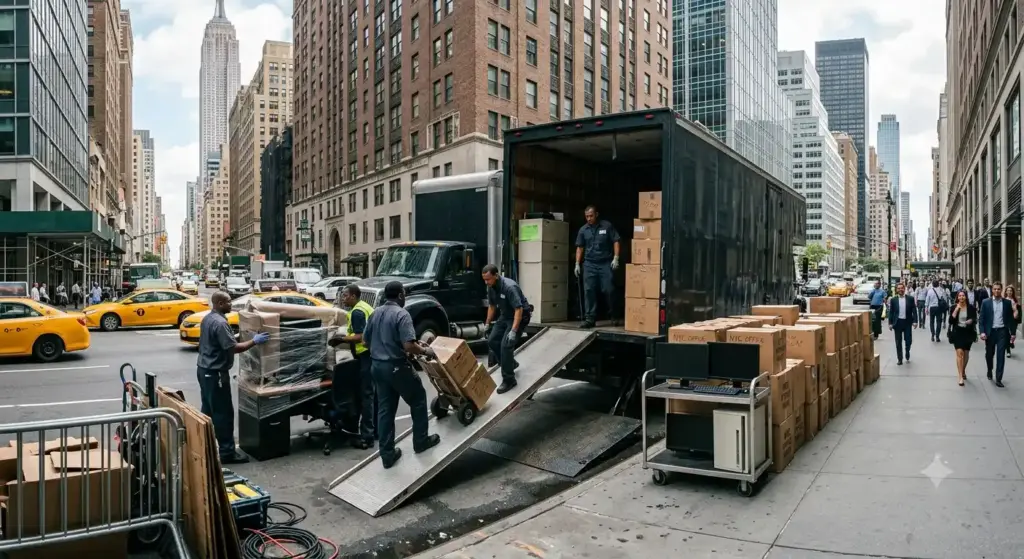
How a Commercial Move Is Defined in NYC
A move is classified as commercial when the items being relocated belong to a business rather than an individual: office furniture, workstations, servers, inventory, retail fixtures, or specialized equipment. The distinction matters because a commercial job involves business property, business insurance requirements, and business building rules, three things a residential move does not touch. A licensed New York mover holds the same DCA license for both residential and commercial jobs, but a commercial job additionally requires general liability and workers’ compensation coverage sized to the property value and building requirements involved.
Commercial vs. Residential Moves: The Real Operational Differences
The two job types look similar from the outside, a truck and a crew, but the planning underneath is different in ways that affect cost, insurance, and scheduling.
Factor | Residential move | Commercial move |
|---|---|---|
Pricing model | Hourly, based on crew size | Usually fixed-scope, based on inventory and access |
Insurance | Basic valuation coverage | General liability and workers’ comp, COI naming the landlord |
Building access | Standard elevator or walk-up | Freight elevator window booked with building management |
Scheduling | Daytime, any weekday | Often nights or weekends to avoid business downtime |
Cargo | Household goods | IT equipment, records, retail fixtures, specialized machinery |
For a deeper look at how to evaluate a mover against these differences before you sign a contract, see reliable commercial moving companies in New York.
Insurance and Certificate of Insurance (COI) Requirements
Most NYC office buildings will not release a freight elevator or loading dock to a moving crew without a Certificate of Insurance naming the landlord or managing agent as an additional insured. This is separate from the mover’s own liability coverage and has to be requested and approved before your move date, not on the morning of. A licensed commercial mover manages this filing directly with building management as a standard part of the job rather than an add-on service.
Every commercial job through Dream Moving includes COI filing as part of the commercial and office moving service, since a denied elevator reservation on moving day is one of the most common causes of a delayed relocation.
What Counts as Commercial Cargo: IT Equipment, Records, and Business Assets
A commercial move involves categories of items a residential move rarely does: server racks and networking equipment, desktop workstations, confidential legal or medical records, retail display fixtures, and specialized machinery specific to the business. Each category has its own handling requirement, disconnecting and labeling IT equipment in sequence so it can be reconnected in the same order, or maintaining chain-of-custody protocols for records that carry legal or regulatory sensitivity.
Not every item in an office qualifies for standard commercial transport. A breakdown of what office movers legally cannot move covers the categories that require separate arrangements, such as hazardous materials or certain client-owned equipment.
Freight Elevators, Building Access, and After-Hours Scheduling
Most Manhattan office buildings restrict freight elevator use to a narrow window, commonly early morning before business hours or after 5 PM on weekdays, and some buildings limit moves to weekends only. This access window has to be confirmed with building management and built into the crew’s schedule before the move date, since arriving without a booked window can mean the crew is turned away at the lobby. This is also why commercial moves default to nights and weekends far more often than residential moves do, since most businesses cannot vacate during a standard workday without stopping operations.
Building access windows also interact with the calendar. See the best time to schedule an office move in NYC for how lease dates and building policies affect the ideal moving date.
How Commercial Moves Are Priced Differently
Residential local moves in New York are billed hourly because the job length is fairly predictable once crew size and building type are known. Commercial moves are usually quoted on a fixed scope instead, based on inventory, floor count, and access constraints, because a business move has more variables that can extend a job: freight elevator delays, phased scheduling across multiple floors, or IT reconnection time that depends on the client’s own systems. A fixed-scope quote protects the business from a job that runs long due to building logistics outside anyone’s control.
A breakdown of what drives the price on a business relocation is covered in the cost to move office furniture in NYC, which walks through the line items that make up a commercial quote.
Who Actually Needs a Commercial Move
Law firms, medical and dental practices, retail stores, tech startups, and warehouses all fall under the commercial classification, even though their moves look different from each other. A law firm relocating confidential files in a Midtown high-rise has different chain-of-custody needs than a retail store relocating fixtures and inventory, but both require the insurance, access planning, and fixed-scope pricing that define a commercial job rather than a residential one.
Dream Moving has coordinated commercial relocations across every borough, from single-suite moves in Manhattan to multi-floor jobs, with the building-access experience that comes from working freight windows in Manhattan high-rises regularly.