

Can You move a pool table without taking it apart?
- Home
- »
- Local Moving
- »
- Can You move a pool table without taking it apart?
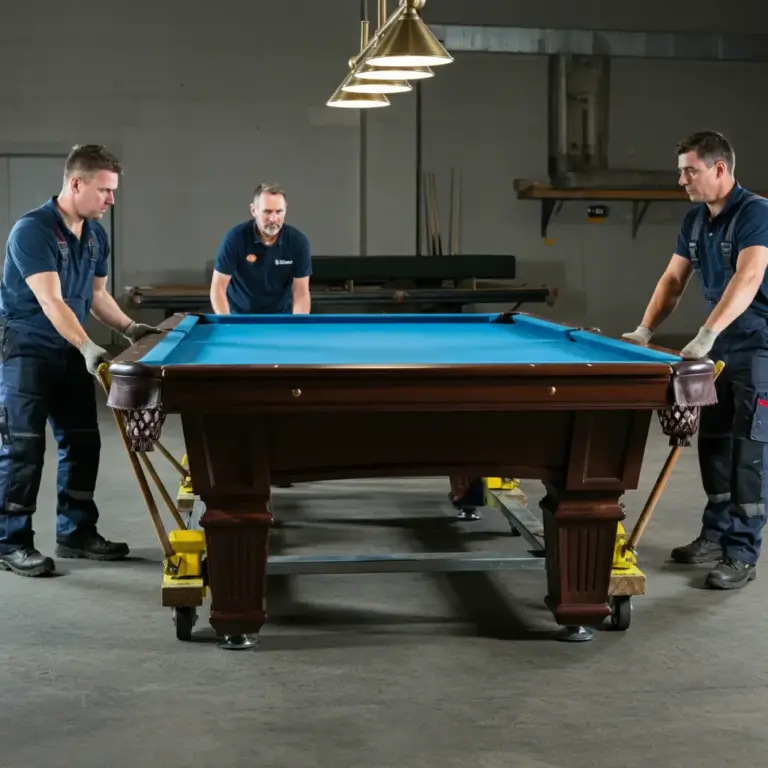
Moving a pool table without disassembly is possible, but only under specific conditions. A standard 9-foot slate pool table weighs between 700 and 1,000 pounds. The slate bed alone accounts for 400 to 450 pounds of that. Moving the table intact requires a flat, obstacle-free route, a minimum of four trained movers, furniture dollies rated for at least 1,000 pounds, and full protective wrapping. In most NYC apartments, walk-ups, and older buildings with narrow hallways and tight stair turns, those conditions are not met, and disassembly becomes the safer and less costly option.
The cost of getting it wrong is high. Cracking a three-piece slate bed costs $800 to $2,000 to replace. Professional pool table moving in NYC runs $300 to $800 for a local move. The math favors calling professionals or disassembling first.
When moving a pool table intact is actually possible?
Not every pool table move requires full disassembly. Intact moves work under these specific conditions:
- The route from the table’s current position to the destination is a single floor with no stairs
- Every doorway along the path is at least 36 inches wide (most 9-foot tables need 54 to 56 inches of clearance with dollies)
- The floor surface is smooth and level throughout
- At least four adults with moving experience are available
- Furniture dollies rated for 1,000 pounds or more are on hand
- The table legs are secured and the slate is not cracked or loose
If any of these conditions are not met, disassembly is the correct approach. Attempting an intact move through a building with stairs, tight corners, or doorways under 36 inches puts both the table and the building at risk.
Moving Made Simple
Get A Free Quote
Within Minutes!
What actually makes a pool table hard to move?
The slate bed
The playing surface of a quality pool table is a three-piece slate bed, each section weighing around 150 pounds. Slate is brittle under uneven pressure. A single jolt or flex in the frame during a turn can crack a slate panel. Replacement requires removing the felt, sourcing matching slate, re-leveling, and re-felting. Total cost: $800 to $2,000 depending on the slate size.
The frame and legs
Pool table frames are built for permanence, not transport. The joints are not designed to flex during movement. Under load shifts common during stair navigation or tight turns, the frame can rack (twist out of square), which permanently affects the level playing surface.
The felt
Moving blankets protect the exterior, but friction against door frames, walls, or floor surfaces can snag and tear the felt. Re-felting a 9-foot table runs $300 to $500 in the New York area.
The weight distribution
The slate bed sits higher than the center of gravity of the frame. This makes the table top-heavy on dollies. Any change in floor slope, a doorway threshold, or an uneven tile joint can cause the table to shift its load toward one dolly, compromising control.
Step-by-step: how professionals move a pool table intact?
This applies only to ground-floor moves with a clear, wide path. For any other situation, disassembly is the correct method.
Step 1: Strip the table surface.
Remove all balls, racks, chalk, and accessories. Clean the felt surface. Verify the slate is not cracked or loose at the seams.
Step 2: Wrap and protect.
Cover the entire table with at least two layers of moving blankets, securing them tightly with stretch wrap or moving tape. Pay extra attention to the pockets and corner blocks, which are the most vulnerable to impact damage.
Step 3: Position the dollies.
Place heavy-duty dollies under the frame at the four corners, distributing the weight evenly. Test each dolly for rolling resistance before committing the full load.
Step 4: Lift as a team.
Four movers, one at each corner, lift simultaneously using leg drive, not back leverage. The table goes onto the dollies in a single coordinated lift with no twisting.
Step 5: Secure before moving.
Strap the table to the dollies with ratchet straps before any movement. A table that shifts on dollies mid-move causes injuries and damage.
Step 6: Move slowly and call every obstacle.
One person leads the front and calls out doorways, thresholds, and turns. Stops are cheaper than damages. Move at walking pace or slower.
Step 7: Lower and check.
Set the table down carefully at the destination. Remove all wrapping and inspect the slate seams and the level of the playing surface before considering the move complete.
Equipment you actually need
Item | Specification | Why it matters |
|---|---|---|
Furniture dollies | Minimum 1,000 lb rated, 4 total | Distributes weight; prevents floor damage |
Ratchet straps | 2-inch webbing, minimum 2 | Secures table to dollies during movement |
Moving blankets | Heavy-duty, at least 6 | Protects felt, slate edges, and pockets |
Stretch wrap | 3 rolls minimum | Holds blankets in place during movement |
Work gloves | Rubber-grip | Grip on the frame during lifts |
Stair-climbing dolly | If any stairs exist | Manual carries cause frame and slate damage |
Pool table moving costs in NYC: what to expect in 2026?
Scenario | Estimated cost range |
|---|---|
Same-floor intact move, local mover | $300 to $500 |
Stairs involved, disassembly and reassembly | $500 to $800 |
Full disassembly, reassembly, re-leveling, re-felting | $800 to $1,500 |
Slate replacement after a damaged move | $800 to $2,000 |
Re-felting after damage | $300 to $500 |
These figures reflect the New York metro area in 2026 and vary by borough, building access, and table size. Manhattan moves with elevator holds or loading dock restrictions typically run toward the top of each range.
NYC-specific challenges that change the calculation
New York City apartments and brownstones were not designed for pool tables. The challenges that regularly force disassembly include:
Narrow hallways
Pre-war buildings in Brooklyn, Queens, and the Bronx commonly have hallways measuring 28 to 32 inches wide. A 9-foot table on dollies needs 54 to 56 inches of clear width.
Tight stairwell landings
Walk-up buildings frequently have 90-degree stairwell turns with landings shorter than 5 feet. There is no way to navigate a table this size through that space intact.
Certificate of Insurance requirements
Luxury buildings and co-ops in Manhattan, Westchester, and on Long Island require vendors to carry specific liability coverage. Professional local moving services include COI handling as standard, which avoids delays on move day.
Elevator restrictions
Many buildings limit freight elevator use to specific hours and require advance booking. Moving a pool table outside a small window can mean storage costs or rebooking fees.
Parking and street permits
Double-parking for the time needed to load a pool table requires a parking permit in most NYC neighborhoods. Professional movers know which permits are needed and handle the application.
When disassembly is the right choice?
Disassembly is the right choice whenever the move involves stairs, hallways narrower than 36 inches, or multiple floors. It is also the right choice for long-distance moves where road vibration over hundreds of miles would risk cracking the slate.
A proper disassembly by trained movers takes 45 to 90 minutes and covers:
- Removing the pockets
- Carefully lifting and labeling each slate panel
- Disassembling the frame and legs
- Padding each piece individually
Reassembly requires re-leveling the slate to within 0.01 inches of level, then re-felting. Most professional movers who handle pool tables include a level check and minor re-felting as part of the reassembly quote.