

Can you move a pool table without taking it apart in NYC?
- Home
- »
- Local Moving
- »
- Can you move a pool table without taking it apart in NYC?
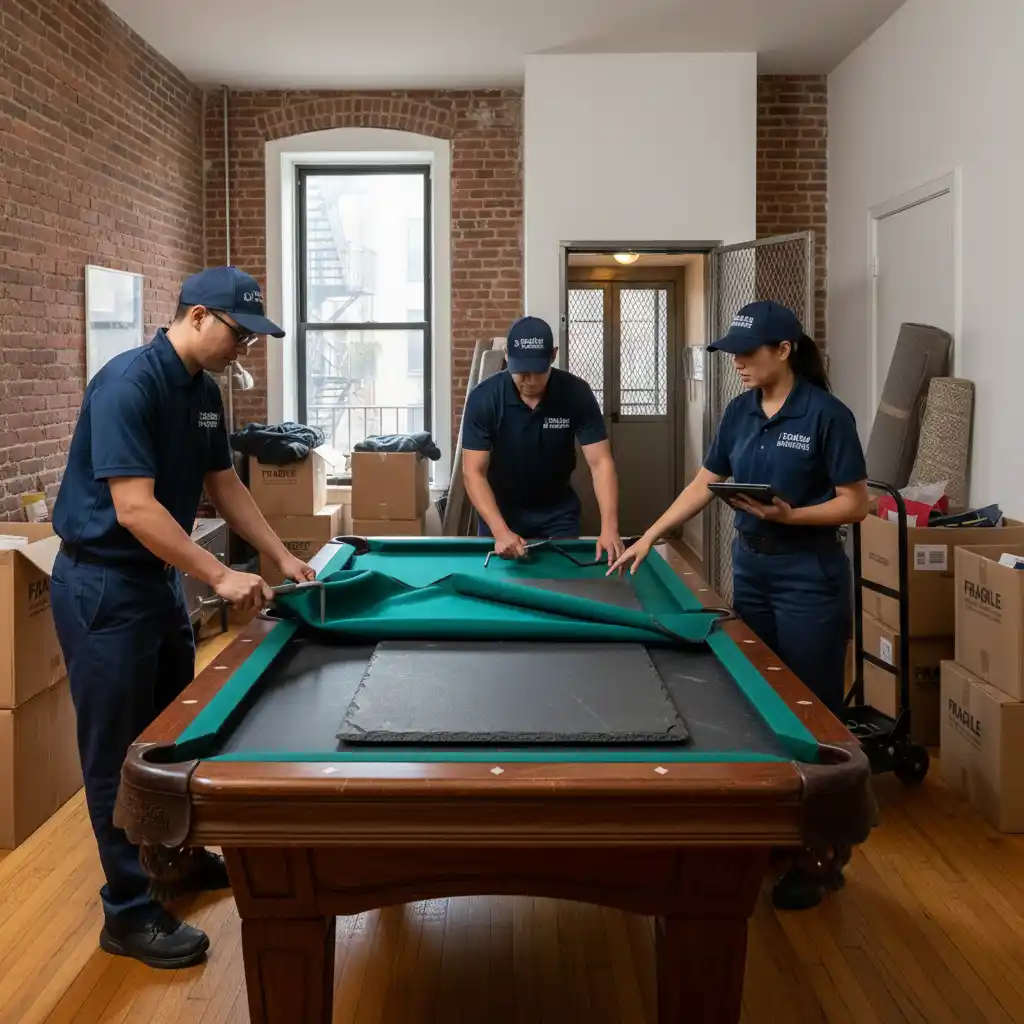
If you own a slate pool table in New York City, you know it is more than just a game; it is a centerpiece of your home and a significant financial investment. When the time comes to relocate, whether you are moving from a brownstone in Astoria to a high-rise in Manhattan, or just across the borough, the temptation to move the table fully assembled is strong. After all, taking it apart seems like a hassle.
However, as NYC’s trusted moving experts, Dream Moving is here to give you the honest answer: No, you cannot safely move a slate pool table without taking it apart.
While it might seem physically possible to lift it with enough manpower, doing so in the context of a relocation is a recipe for disaster. Between the structural fragility of the table and the tight logistical squeeze of New York City architecture, disassembly is not just a suggestion, it is a requirement.
Can a slate pool table be moved without taking it apart?
Technically, there is a very specific exception to the rule, but it likely does not apply to a move involving a truck.
Feasibility
Moving a slate pool table intact is only viable for “micro-moves.” For example, if you are having new flooring installed and need to slide the table five feet to the left within the same room, this can sometimes be done using specialized hydraulic dollies that lift the table from the legs.
Relocation reality
For any actual relocation involving a moving truck, stairs, or elevators, disassembly is mandatory. The sheer physics of a slate table make it impossible to transport safely as a single unit.
Risk factor
According to manufacturers like A.E. Schmidt, a standard 8-foot slate pool table can weigh between 850 and 1,200 pounds. Transporting this much weight as a single unit causes massive structural torque. When a table is lifted by its sides or tilted, the frame twists, often cracking the slate and warping the wood cabinet beyond repair.
Why is moving a fully assembled pool table dangerous for the furniture?
Many owners assume a pool table is a solid slab of rock on sturdy legs. In reality, it is a precision-engineered instrument made of separate components that are not designed to be moved as one piece.
Slate integrity
Most residential tables feature a three-piece slate bed. These three heavy slabs of stone sit side-by-side and are sealed together with beeswax or specialized putty to create a seamless playing surface. If you lift the table by the corners or rails, the frame flexes. This movement breaks the wax seals instantly and can cause the slate edges to grind against each other, leading to chipping or cracking.
Frame torque
The wooden side rails and cabinet are designed to support the downward weight of the slate when the table is stationary. They are not designed to hold that weight when the table is tilted or lifted. Attempting to carry a 1,000-pound table by the rails often causes the screws to pop and the wood to crack under the strain.
Pop-off rails
To fit through doors, amateur movers often try “keyboarding” the table (tilting it on its side). Because the slate is not bolted to the rails in a way that supports sideways gravity, the heavy slate often crashes right through the side rails, destroying the table and potentially injuring the movers.
What are the specific challenges of moving pool tables in NYC apartments?
Even if the table were indestructible, New York City architecture presents a whole new set of obstacles. At Dream Moving, we navigate the unique constraints of the 5 boroughs daily, and we know exactly why a fully assembled table won’t fit.
Elevator constraints
Standard residential and even freight elevators in NYC have strict dimension limits. According to elevator planning guides from major manufacturers like TK Elevator, a typical passenger elevator car is often less than 8 feet wide or deep. An assembled 8-foot or 9-foot pool table simply will not fit horizontally, and standing it vertically is too tall for the cab ceiling (usually 8 feet).
Narrow hallways
Pre-war buildings in neighborhoods like Astoria or the Upper West Side are famous for their solid construction and narrow layouts. These buildings often feature tight 90-degree turns leading into apartments. A solid object that is 50 to 60 inches wide cannot make those turns without destroying the doorframes or getting permanently wedged.
Walk-up issues
Manually carrying an 800-pound assembled unit up a flight of stairs is physically impossible. The weight distribution is dangerous for the crew, and the likelihood of damaging the building’s walls or stair railings is near 100%.
What does the pool table disassembly process involve?
To ensure your table arrives at your new home in perfect condition, our team follows a strict disassembly protocol. This isn’t just about taking things apart; it’s about preparing them for safe travel.
- Removal of pockets and side rails
We carefully unbolt the side rails and pockets, labeling all hardware so reassembly is seamless. - Careful removal of felt
If the felt is in good condition and you wish to reuse it, we carefully remove the staples or glue. However, many clients choose to replace the felt during a move to give the table a fresh look. - Unbolting the three slate slabs
This is the most critical step. We unbolt the three individual pieces of slate. These are then wrapped and crated individually. This transforms one unmanageable 800-pound object into three manageable 250-pound pieces. - Disassembling the frame and legs
Once the slate is off, the wooden frame and legs are disassembled. This allows the components to fit easily through standard NYC doorways and into elevators.
Does a pool table need to be re-leveled after a move?
Yes, absolutely. Even if you managed to move a table whole (which, again, we advise against), it would no longer be level at the new location.
Vibration impact
During transit, truck vibrations and handling inevitably shift the alignment of the slate. Even a millimeter of shift ruins the game.
Re-leveling necessity
Once we arrive at your new home, professional technicians must use precision machinist levels to re-install the slate. We use shims to ensure the surface is perfectly flat relative to the new floor (which, in NYC, is rarely perfectly level itself).
Sealing
After leveling, fresh beeswax must be applied to the seams between the slate pieces. This is heated and smoothed out to ensure the balls roll over the cracks without any deviation. This process is impossible if the table is kept assembled.
Do NYC buildings require a Certificate of Insurance (COI) for pool table moves?
If you live in a building with a management company or a co-op board, the answer is almost certainly yes.
Management requirements
Due to the heavy nature of slate tables and the potential for damage, Realty Times notes that co-op boards and management companies strictly enforce insurance requirements. They want to ensure that if a heavy piece of slate gouges a hallway floor or damages an elevator, the cost is covered.
Coverage
A Certificate of Insurance (COI) protects the building’s property. With elevator door replacements potentially costing up to $15,000, buildings do not take risks with uninsured movers.
Dream Moving role
We are a fully insured moving company. We issue COIs directly to your building management to gain authorization for elevator use and move-in access. We handle the paperwork so you don’t have to worry about being denied entry on moving day.
Let the professionals handle the heavy lifting
Moving a pool table in New York City is a complex operation that requires strength, precision, and respect for the mechanics of the table. Attempting to cut corners by moving it fully assembled puts your expensive gaming table, your building, and your movers at risk.
At Dream Moving, we have the expertise to disassemble, transport, and reassemble your table so it plays perfectly in your new home. We take the stress out of the process, ensuring your only concern is who breaks the rack first.
Ready to plan your move? Contact us today for a free quote.